
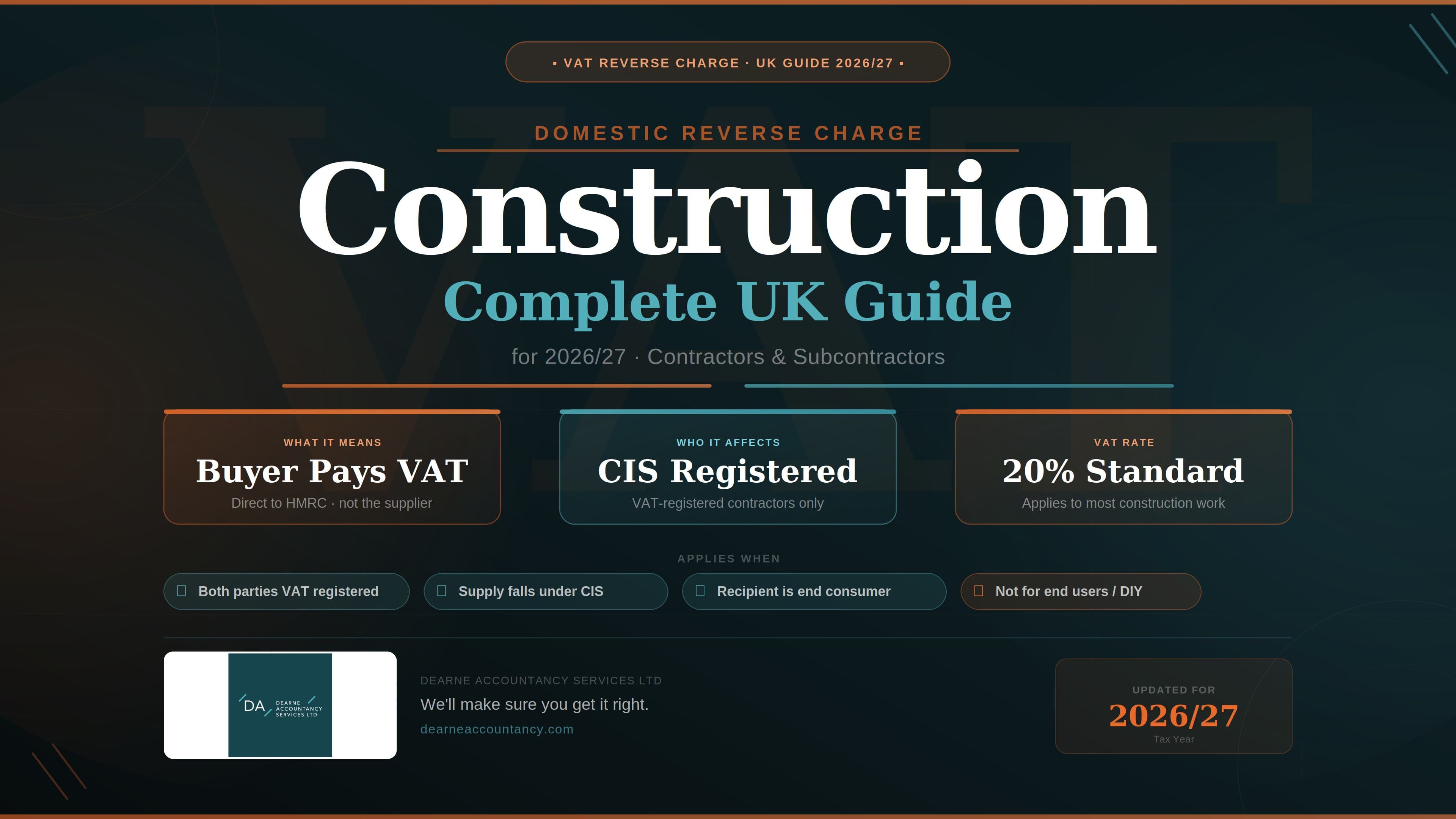
Yorkshire construction Ltd directors who come to me at first review almost always have at least one DRC error sitting in their books. Sometimes from March 2021, when the rules came in. Sometimes from last quarter. Either way, the refund attached to it is still with HMRC — quietly, indefinitely, waiting. It doesn’t come back on its own.
I’m Sarah Bingham. I’ve been running Dearne Accountancy Services since November 2020. Most of my clients are construction Ltds across South Yorkshire and West Yorkshire, and this is the guide I wish more had read in their first month of trading. If you want the wider view of construction-specific accounting, the Construction Accountants hub sits over the top of this piece.
If you only read one section: the five DRC mistakes I find most often when I onboard a Yorkshire construction Ltd. If any ring true, the rest of this guide is the fix.
- Assuming the tier-1 contractor is the end user without written notification. They aren’t — not unless they’ve told you in writing. Until then, you reverse-charge the invoice.
- Continuing to charge 20% VAT on jobs that should be DRC. It sits in your Box 1. HMRC has been paid VAT they didn’t need. Your customer can’t recover it because the invoice is wrong. Both sides lose.
- Plant hire with operator treated as plant hire without. The first is in CIS scope and almost always DRC. The second isn’t. The line matters.
- Mixed-supply contracts not handled under the 5% disregard rule. Either invoiced as fully standard when they should be fully DRC, or split needlessly into two invoices.
- Never going back to fix the first year of DRC (March 2021–March 2022). That window is now over four years old in most cases, meaning the time limit to correct it is already gone or going. If you haven’t looked, look this week.
What is the Domestic Reverse Charge, in one paragraph?
The Domestic Reverse Charge (DRC) is a VAT accounting rule that flips who pays the VAT on a construction invoice. Normally the supplier (the subbie) charges VAT to the customer, collects it, and pays it to HMRC.
Under DRC, the supplier doesn’t charge VAT at all. The customer self-accounts for both the output VAT and (where recoverable) the input VAT on their own VAT return. The net effect for the customer is nil, but HMRC sees the supply and the VAT in one set of records instead of two.
It took effect on 1 March 2021. HMRC introduced it to shut down a fraud pattern called “missing trader” VAT, where subbies were charging VAT, getting paid by the contractor, and disappearing without paying HMRC. The mechanic is set out in VAT Notice 735 — the DRC technical guide, last updated 18 September 2024.
Who’s in scope and who’s out: the five conditions
A supply only falls under DRC when all five of the following are true. Miss one, and DRC doesn’t apply — you’re back to standard VAT.
- Both parties are VAT-registered in the UK. If your customer isn’t VAT-registered, charge VAT normally.
- The services are within the scope of the Construction Industry Scheme (CIS). This is the big one. If CIS doesn’t apply, DRC doesn’t either. See the in-scope and out-of-scope tables below. There’s more depth on CIS in our CIS tax guide for 2026/27 subcontractors.
- The services are standard-rated or reduced-rated. Zero-rated supplies (for example, qualifying newbuild residential work) are excluded. This is why the newbuild question keeps coming up, covered below.
- You’re not an employment business supplying staff or workers. Labour-only labour agencies sit outside DRC, even when the work itself would qualify.
- Your customer hasn’t given written confirmation that they’re an end user or intermediary supplier. Once they do, DRC stops applying to that customer’s invoices.
Source: HMRC’s supplier flowchart in the DRC technical guide.
There’s a sixth gate worth knowing: if both parties are part of the same VAT group, the supply between them isn’t a supply for VAT purposes at all, so DRC doesn’t bite. Rare on a Yorkshire site; common inside larger national contractor groups.
Construction services within scope
CIS scope drives DRC scope. If a job is within CIS, it’s almost certainly within DRC (subject to the other four conditions above). HMRC’s list of services that fall within DRC because they fall within CIS is broad and covers most things a site team does day to day.
| Service | Notes |
|---|---|
| Construction, alteration, repair, extension, demolition or dismantling of buildings or structures | Core CIS work |
| Construction, alteration, repair or demolition of works forming part of the land (walls, roadworks, power lines, drainage) | Civils |
| Installation in a building of heating, lighting, air conditioning, ventilation, water, drainage or sanitation systems | M&E first-fix and second-fix |
| Internal cleaning of buildings during the course of construction | Site clean before handover, not post-occupancy |
| Painting and decorating the internal or external surfaces of any building | Including spray work |
| Site clearance, earth-moving, excavation, tunnelling, foundations | Groundworks |
| Scaffolding hire with labour (erect/dismantle) | Counts as construction service |
Full list and edge cases sit in VAT Notice 735. Where you’re not sure whether a service is in CIS, the CIS scope decision drives the DRC answer. We file CIS returns for construction Ltds across South Yorkshire if you’d rather the scope decisions sat with us.
Construction services outside scope
These look like construction but aren’t, for CIS/DRC purposes. Charge standard VAT.
| Service | Why it’s out |
|---|---|
| Professional services of architects, surveyors, building or site consultants | Not within CIS |
| Drilling for or extraction of oil or natural gas | Excluded from CIS |
| Extraction of minerals; tunnelling for, or boring or construction of, underground works for that purpose | Mineral extraction |
| Manufacture of building or engineering components, equipment, materials, plant or machinery delivered to site | Manufacturing is out; installation may be in |
| Manufacture of components for heating, lighting, air-con, ventilation systems delivered to site | Same logic |
| Sign-writing and erecting, installing and repairing signboards and advertisements | Out by exception |
| Installation of seating, blinds and shutters | Out by exception |
| Installation of security systems (alarms, CCTV, public-address) | Out by exception — catches a lot of M&E firms by surprise |
Materials-only supplies with no labour are outside CIS, so outside DRC. Pure design and consultancy is outside.
Source: VAT Notice 735.
DRC vs zero-rate construction VAT: the newbuild confusion
This is the single most common DRC question I get from contractors working on housing schemes. Short version: if a supply is zero-rated, it’s outside DRC. DRC only catches standard- or reduced-rated supplies. So the order of questions matters:
- Is this supply zero-rated under the construction zero-rate rules (qualifying newbuild dwelling, qualifying relevant residential or charity building)? Yes → zero-rate the supply. DRC does not apply. No → go to question 2.
- Is this supply standard- or reduced-rated, within CIS scope, between two VAT-registered parties, where the customer hasn’t notified end-user status? Yes → DRC applies. No → standard VAT applies as normal.
In practice, on a newbuild residential site you’ll routinely have zero-rated work alongside standard-rated work (alterations to existing fabric on a mixed scheme, for example). The two sit side by side. The VAT treatment of each line is decided line by line, not site by site.
The end-user rule: the most-missed part
End user is the part of DRC most generalist accountants get wrong, because it lives outside the rules themselves — it’s a behaviour change. Until your customer tells you in writing that they are an end user or intermediary supplier, you have to reverse-charge them. The default is DRC; end-user status is an opt-out.
Who counts as an end user. A VAT- and CIS-registered business that doesn’t make onward supplies of the construction services it receives. Property developers consuming the building work themselves often qualify. Tier-1 main contractors usually do not, because the work is going further down the chain.
Who counts as an intermediary supplier. A VAT- and CIS-registered business connected or linked to an end user, either with a relevant interest in the same land where the construction works happen, or part of the same corporate group (defined under section 1161 of the Companies Act 2006). Joint-venture vehicles often qualify.
The notification. HMRC accepts written notification by post, by email, or inside the contract itself. The suggested wording (use this verbatim and nobody can argue):
We are an end user for the purposes of section 55A VAT Act 1994 reverse charge for building and construction services. Issue us with a normal VAT invoice, with VAT charged at the appropriate rate. We will not account for the reverse charge.
No notification, no opt-out. I see contractors assume the developer is the end user every week. They might be. They might not. Get it in writing.
Source: DRC technical guide.
The 5% disregard rule (one way only)
If you’re invoicing a single supply where one minor element falls outside DRC, the 5% disregard lets you treat the whole supply as DRC and stop splitting it. HMRC’s wording:
If the reverse charge part of the supply is 5% or less of the whole supply value this can be disregarded… Normal VAT rules will apply if the customer makes an end user or intermediary supplier notification.
The example HMRC gives is “supply and fix works”: a single supply where the bulk is in-scope construction work and a small element (incidental materials, say) sits outside.
Important: this works one way, not both. It absorbs a small non-DRC element into a mostly-DRC supply. It does not absorb a small DRC element into a mostly-standard supply. I see this misquoted constantly. If 95% of your contract is standard-rated work and 5% is in-scope construction, you don’t get to call the whole lot standard — you have to split it.
Worked example. A £50,000 single supply contract to fit out a commercial unit. £48,500 is in-scope construction work; £1,500 is incidental supplies that on their own would sit outside DRC. The £1,500 is 3% of the contract. Apply the disregard: the whole £50,000 invoice goes out under DRC.
Source: DRC technical guide.
Plant hire: with operator vs without
The line between plant hire that’s caught by DRC and plant hire that isn’t comes down to whether an operator is supplied with the plant.
- Hire of plant or equipment with an operator = a supply of construction services within CIS scope, so DRC applies (subject to the five conditions in scope above). Think excavator with driver, crane with operator, traffic-management vehicle with operator.
- Hire of plant or equipment only, with no operator = a supply of goods, outside CIS, outside DRC. Standard VAT applies. HMRC’s wording: “The hire of goods only is not within the scope of the Construction Industry Scheme and therefore the reverse charge does not apply to the hire charge.”
The newbuild exception worth knowing. HMRC’s technical guide says: “The supply of operated plant or machinery used on new build housing developments is zero-rated and not subject to the reverse charge.” So an operated-plant supply that would normally be DRC drops to zero-rate when the site is qualifying newbuild residential.
I see this trip up Doncaster firms on M62-corridor logistics jobs more than anywhere — mixed plant operations, some with operator and some without, on the same week’s billing.
Source: DRC technical guide.
How to invoice under DRC, with a worked example
A DRC invoice has to do everything a normal VAT invoice does, plus carry specific reverse-charge wording so the customer knows to self-account. The required elements:
- All normal VAT invoice contents (date, invoice number, supplier name plus VAT number, customer name plus address, description, net amount).
- A note that the domestic reverse charge applies and the customer is responsible for accounting for the VAT.
- The VAT rate that would have applied, or the amount of VAT that would have been due, so the customer knows what to self-account.
- The literal reference “reverse charge” on the invoice, as required by the VAT regulations.
- No VAT charged in the totals line.
HMRC gives two acceptable phrasings — pick one and use it consistently:
- “VAT Act 1994 Section 55A applies”
- “Customer to pay the VAT to HMRC”
Either is fine. The word “reverse charge” must appear somewhere on the invoice.
Worked example — subbie billing a tier-1 contractor:
INVOICE 2026/047
First-fix electrical works, Phase 2
Net amount: £8,400.00
VAT: £0.00 — Reverse charge: customer to pay the VAT to HMRC (VAT Act 1994 Section 55A applies)
Total payable: £8,400.00
VAT rate that would have applied: 20% (£1,680.00). Customer to self-account.
The customer pays £8,400 and self-accounts for the £1,680 of output VAT on their own return, recovering it in the same return if fully recoverable.
Self-billing. Where the customer raises the invoice on the supplier’s behalf, the same reverse-charge marking has to appear. The mechanic doesn’t change. If you’d rather we handled the VAT returns for you, that’s what we do.
How to fill in your VAT return under DRC
The VAT-return treatment is asymmetric: the supplier and the customer each fill in different boxes for the same supply.
| Box | Supplier (subbie) | Customer (contractor) |
|---|---|---|
| Box 1 — Output VAT | Nothing | The VAT that would have been charged, self-accounted as output |
| Box 4 — Input VAT recovery | Nothing | The same VAT figure recovered as input (if fully recoverable; restricted if partly exempt) |
| Box 6 — Net value of outputs | Net value of the supply | Nothing (this isn’t your sale) |
| Box 7 — Net value of inputs | Nothing | Net value of the purchase |
Net effect on the customer’s return: nil VAT to pay (Box 1 in = Box 4 out), but the supply is properly recorded for HMRC visibility.
Cash Accounting Scheme. “You cannot use the VAT Cash Accounting Scheme for supplies or services you buy or sell that are subject to the reverse charge.” DRC supplies stay on accruals. The cash mechanic doesn’t apply to them, even if the rest of your VAT accounting is on cash.
Flat Rate Scheme. “Reverse charge supplies are not to be accounted for under the scheme.” This is the one that catches small Ltds.
If you’ve been on FRS and you’ve started doing DRC work, your FRS calculation needs adjusting to strip DRC supplies out. Many small contractors are better off coming off FRS entirely once DRC kicks in. Get a comparison run before your next return.
Sources: VAT Notice 700/12; DRC technical guide.
How to fix DRC errors on past returns
This is the section I rewrite for clients more than any other. There’s a long pattern of contractors discovering year-one DRC errors (March 2021 to March 2022) and not knowing the mechanic for fixing them, particularly since HMRC retired the old VAT 652 form.
Step 1 — Quantify the error. Pull every invoice in the affected period and recalculate what should have been DRC against what was actually charged. Get to a single net under- or over-declared VAT figure across all periods.
Step 2 — Check which Method applies. From VAT Notice 700/45 (updated 5 September 2025):
- Method 1 — adjust on next VAT return: net error ≤£10,000, or net error between £10,000 and £50,000 if it’s within 1% of the Box 6 turnover declared for the period when the error is discovered.
- Method 2 — separate disclosure: net error >£50,000, or £10,000–£50,000 exceeding the 1% test, or deliberate errors at any value.
Step 3 — If Method 1, adjust the next return. Add or subtract the net VAT figure from Box 1 (output VAT) and/or Box 4 (input VAT) as appropriate. Keep a written note in your VAT account showing the reason, the period the error happened in, and the calculation.
Step 4 — If Method 2, notify HMRC separately. Form VAT 652 has been retired. HMRC’s current statement: “You can no longer correct errors in your VAT Returns using form VAT652” (8 September 2025). Use HMRC’s online error reporting service via your business tax account at tax.service.gov.uk, or send the disclosure in writing to the VAT Error Correction Team.
Step 5 — Mind the 4-year time limit. Corrections must be made within four years of the end of the VAT period in which the error happened. No time limit applies to deliberate errors. The original March 2021 DRC quarter is already outside that window for most quarterly filers — anything you find for that quarter now can’t be reclaimed. The April–June 2021 quarter is on the edge. Look this week, not next month.
Sources: VAT Notice 700/45; Check how to tell HMRC about VAT Return errors.
Frequently asked questions
Do I need to charge VAT to my construction customer if both of us are VAT-registered?
Not if the supply meets all five DRC conditions (VAT-registered customer, CIS-scope work, standard- or reduced-rated, you’re not an employment business, customer hasn’t notified end-user status). In that case you don’t charge VAT — you mark the invoice as reverse charge and the customer self-accounts. If any condition isn’t met, charge VAT as normal.
What is the 5% disregard rule in simple terms?
It lets you avoid splitting a contract where almost all the supply is DRC and a tiny minor element isn’t. If the non-DRC part is 5% or less of the total contract value, you can ignore it and treat the whole supply as DRC. It only works that way round — it doesn’t let you absorb a small DRC element into a mostly-standard contract.
How do I know if my customer is the end user?
You don’t, unless they tell you in writing. Until you have written notification (post, email or contract clause), you have to apply DRC. Don’t assume. Assumption is the most common DRC mistake I see.
What happens if I got DRC wrong for a whole year?
Quantify the net VAT under- or over-declared across all affected periods. If it’s ≤£10,000 net (or ≤£50,000 within 1% of your current Box 6 turnover), adjust on your next VAT return. Above that, notify HMRC separately via the online service. 4-year time limit applies from the end of each affected period.
Does DRC apply to plant hire?
Plant hire with an operator = within CIS = DRC (unless the site is qualifying newbuild residential, in which case it’s zero-rated). Plant hire only, no operator = outside CIS = standard VAT.
Can I use the Flat Rate Scheme if I make DRC supplies?
DRC supplies must be stripped out of FRS calculations. If most of your turnover is DRC, FRS often stops being worthwhile. Get a comparison run before your next VAT period.
Do I still need to issue an invoice for a DRC supply?
Yes — exactly the same as a normal VAT invoice, plus the reverse-charge wording and the word “reverse charge”. No VAT charged.
What’s the difference between DRC and zero-rated VAT for construction?
Zero-rated = a standard VAT rule of 0% (qualifying newbuild dwellings, etc.). Supplier issues a zero-rated invoice; customer recovers nothing because nothing was charged. DRC = a standard-rated supply where the customer self-accounts instead of the supplier collecting. Supplier issues a no-VAT invoice marked “reverse charge”; customer self-accounts. Zero-rate beats DRC where both could apply, because zero-rate is checked first.
Want a second pair of eyes on your DRC?
If you’re a construction Ltd in South Yorkshire or West Yorkshire and you haven’t been back through your VAT returns since DRC came in, that’s where I’d start.
I run a free 30-minute review for new contacts — bring your last 12 months of returns and a sample of invoices and I’ll tell you honestly whether there’s money to go back for. If there is, we’ll work out together whether it’s worth correcting. If there isn’t, you’ll know that too. Get in touch.
Sources & further reading
- VAT Notice 735 — DRC technical guide (last updated 18 September 2024)
- VAT Notice 700/12 — How to fill in and submit your VAT Return (last updated 19 December 2025)
- VAT Notice 700/45 — How to correct VAT errors and make adjustments or claims (last updated 5 September 2025)
- Check how to tell HMRC about VAT Return errors (last updated 8 September 2025)