
Missing the self assessment deadline is one of the most common situations that lands on my desk in February, and it is almost always more recoverable than people think when they first call. The part that makes it damaging is not the act of missing it. It is what happens in the weeks and months afterwards when nothing is done.
Penalties that start small compound quickly into amounts that are considerably harder to deal with than the original tax bill. This guide tells you where you currently stand, what HMRC will do at each stage, and what you need to do today.
QUICK ANSWER
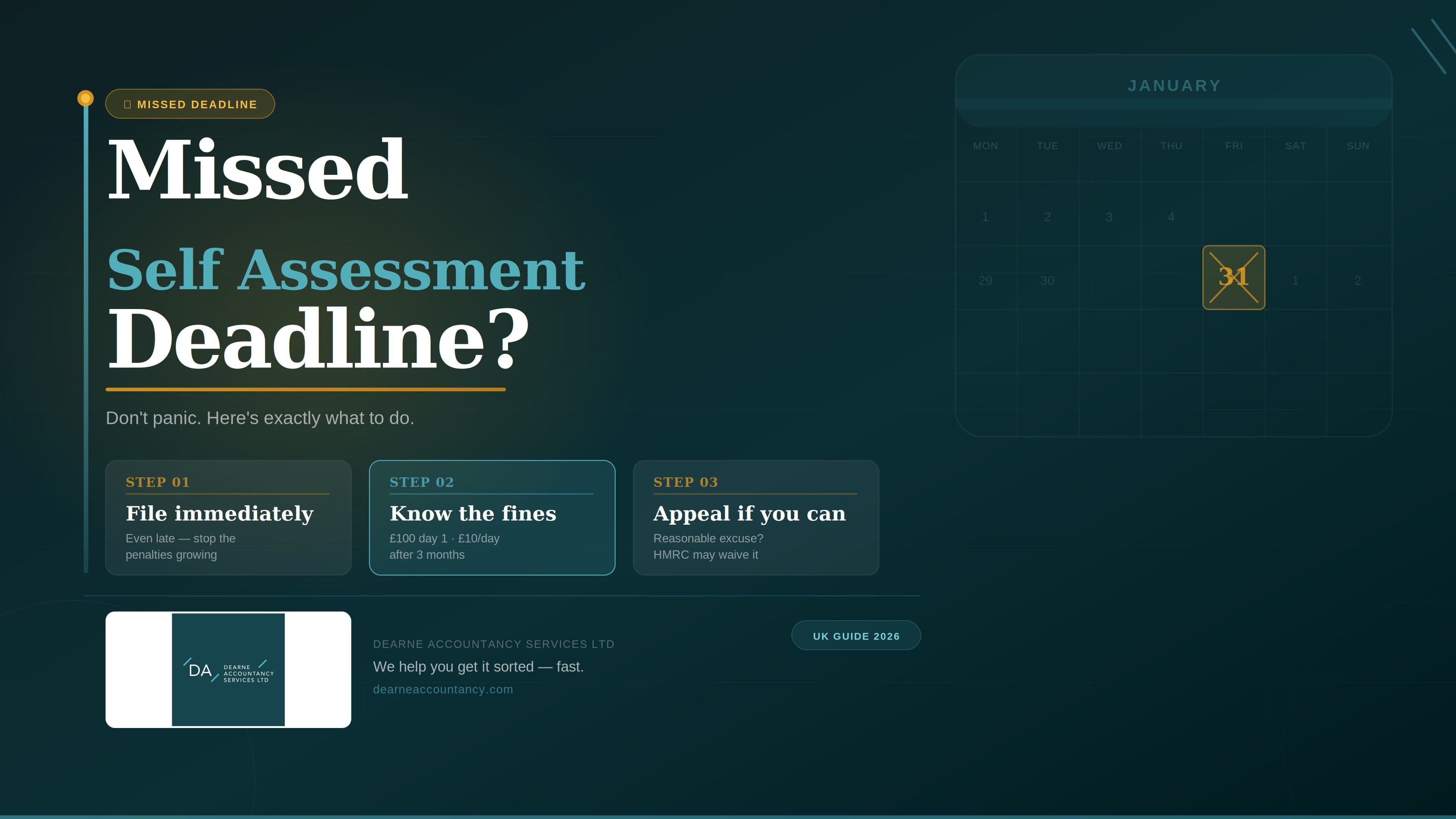
A missed self assessment deadline generates an automatic £100 charge from day one whether you owe tax or not. At three months past the deadline HMRC adds £10 for every day the return remains unsubmitted up to a ceiling of £900.
Six months in, a further charge of £300 or 5% of the outstanding tax is applied, whichever produces the larger amount. Getting your return submitted immediately halts the daily penalty clock regardless of whether you can pay the tax at the same time.
The Key Dates and What They Trigger
Understanding where you are in the penalty timeline is the starting point for deciding what to do next.
| Date | What Happens |
|---|---|
| 5 April | Tax year ends |
| 5 October | Final date to register for Self Assessment if you are doing so for the first time |
| 31 January | Online return filing deadline and payment due date |
| 1 February onwards | £100 automatic penalty applied to every late return |
| 30 April (3 months late) | Daily £10 charges begin, running for up to 90 days |
| 31 July (6 months late) | £300 or 5% of outstanding tax added, whichever is greater |
| 31 January following year (12 months) | Further £300 or 5% added. Can rise to 100% of tax if HMRC considers delay deliberate |
These dates mark the points where new charges kick in. They do not mark points where existing charges stop. The £100 sits on your account from the moment you miss the deadline until the matter is resolved.
The daily charges accumulate continuously from 30 April until your return is filed. Filing at any point stops the forward accumulation but does not remove what has already been applied.
What HMRC Does After a Missed Self Assessment Deadline
HMRC's first action is an automated penalty applied to your account. No letter is required for this to happen and no warning is given. The system applies the charge as soon as the deadline passes.
Shortly afterwards a penalty notice is posted to your last known registered address. If your address with HMRC is out of date, this correspondence goes to the wrong place.
The penalties do not pause while letters fail to arrive. Subcontractors who have moved address without updating HMRC often discover months of accrued charges when they eventually engage.
HMRC treats late filing and late payment as entirely separate matters. The filing penalty is charged because you did not submit a return on time.
The payment penalty is charged because tax remained unpaid past the due date. You can have one without the other. Understanding this distinction is what drives the most important decision in this situation.
File the Return Now, Regardless of Whether You Can Pay
This is the rule that resolves more damage than anything else. A significant proportion of people who have missed the self assessment deadline delay filing further because they know they cannot pay what they owe and assume there is no point submitting until they can. That reasoning costs them money.
Filing the return stops the daily penalty clock immediately. It does not trigger a demand for immediate payment. Payment and filing are two separate actions with two separate timelines. Getting the return in while the payment is still being arranged is always better than leaving both outstanding together.
If you are registered for Self Assessment and need to file urgently, your HMRC online account accepts returns at any time. A submitted return carries a confirmation reference number. Without that number in your account, HMRC has not received it.
Where records are missing or incomplete, file using your best available estimates. HMRC accepts this. You can submit a corrected version any time within 12 months of the original deadline once accurate figures are to hand. An imprecise return filed today protects you from charges that an accurate return filed in two months cannot undo.
What to Do If You Cannot Pay the Tax Bill
Taxpayers who cannot settle their bill immediately have a formal route available to them: a Time to Pay arrangement. This is an agreement between you and HMRC to clear the outstanding balance in monthly instalments over an agreed period, usually between 6 and 12 months.
The process depends on how much you owe.
- If the balance is under £30,000, the arrangement can be set up online through your HMRC account without any phone call or discussion.
- Amounts above £30,000 require you to call HMRC's Self Assessment helpline on 0300 200 3310 and speak with someone directly.
- HMRC will ask about your monthly income and regular outgoings to reach a figure you can realistically meet.
- Interest accrues throughout the arrangement on the outstanding balance, but penalty surcharges for late payment are suspended while you maintain the agreed schedule.
- If you miss an instalment the arrangement ends and HMRC's enforcement options become available immediately.
The window for proactive contact matters. Calling HMRC before they write to you about an overdue debt positions the conversation differently from responding to a demand. HMRC's debt management team has more flexibility in the early stages of a case than once formal recovery has begun.
When a Penalty Appeal Will Succeed and When It Will Not
HMRC allows taxpayers to challenge a late filing penalty where a genuine reasonable excuse can be demonstrated. The bar for what qualifies is higher than most people expect and the evidence requirement is taken seriously.
| HMRC Will Accept | HMRC Will Not Accept |
|---|---|
| The death of a close family member shortly before or on the deadline | Forgetting the deadline exists |
| A serious illness or medical emergency that made filing impossible | Being occupied with work, family, or other commitments |
| An unplanned hospital admission for yourself or a dependent | Relying on a third party who failed to file on your behalf |
| A verified technical failure on HMRC's own systems | Claiming not to have received a reminder or notice |
| A major unexpected event such as a fire or flood destroying records | Not knowing you were required to file |
An appeal must be lodged within 30 days of the penalty notice date. This can be done online through your HMRC account or by post. The appeal must state the reason clearly and include supporting documentation.
A medical letter, death certificate, or screenshot of an HMRC system error message are the kinds of evidence that carry weight. A written explanation without supporting documents rarely succeeds.
If HMRC rejects the appeal, a formal review by a different officer can be requested. After that, the Tax Tribunal is available as a final route.
Neither requires a legal representative, though the Tribunal route involves a more structured process and timeline.
What You Need to File Your Return Today
Pulling together what you have and submitting as soon as possible is the priority. Here is what the return requires.
- Your Unique Taxpayer Reference, a 10-digit number on any previous HMRC letter or visible in your online account.
- Your National Insurance number.
- Income figures for the full tax year: salary from employment (P60 or P45), self-employment earnings, rental income, investment income.
- Expense records for the year if you are self-employed or a landlord. Estimates are acceptable where exact figures are unavailable.
- Any CIS payment and deduction statements if construction industry deductions apply to your income.
- Records of pension contributions, Gift Aid donations, or other reliefs you intend to claim.
If records have been lost entirely, HMRC holds employment and CIS deduction information on file and can confirm figures on request.
For clients in Barnsley and Sheffield who need a late return filed urgently, we regularly submit on the same day using whatever records are available.
Frequently Asked Questions
Do I get a penalty if I owe no tax after missing the self assessment deadline?
Yes. HMRC's £100 automatic penalty is triggered by the act of filing late, not by having unpaid tax. Subcontractors with a refund due, employees with no extra tax liability, and anyone else whose return shows nothing owed all receive the same £100 charge the moment the deadline passes without a filed return.
Will HMRC chase me if I miss the self assessment deadline?
HMRC sends penalty notices by post to your registered address. If your address is out of date those letters go elsewhere while the penalties continue building. Waiting for HMRC to make contact is not a safe strategy. The charges accrue regardless of whether correspondence reaches you.
What is a Time to Pay arrangement with HMRC?
A Time to Pay arrangement lets you spread an outstanding tax bill across monthly instalments agreed with HMRC. For balances under £30,000 you can set one up online. Larger amounts require a phone call. Interest continues during the arrangement but further penalty surcharges are suspended while you maintain the agreed payments.
What counts as a reasonable excuse for missing the self assessment deadline?
A reasonable excuse must be something that genuinely prevented you from filing and that you could not have planned around. Serious illness, bereavement, unplanned hospital admission, and HMRC system failures on the day all qualify. Being busy, forgetting, relying on someone else to file, and not knowing about the deadline do not qualify under any circumstances.
Can I file a Self Assessment return using estimates if my records are incomplete?
Yes. Filing with best estimates stops the daily penalties and gets HMRC a return to process. You then have up to 12 months from the original filing deadline to submit a corrected version with accurate figures. A return with estimated numbers that you later correct is always a better position than continuing to accumulate daily charges while searching for exact records.
The One Thing That Changes Everything Right Now
Every situation involving a missed self assessment deadline has its own specifics. The size of the penalty, whether tax is actually owed, and whether an appeal has any realistic chance of succeeding all vary from one person to the next.
What does not vary is the direction of travel when nothing is done. Penalties grow. Options narrow. The cost of inaction increases every single day.
Whether you missed the self assessment deadline last week or last year, filing the return today is the action that starts resolving it.
Looking at the bigger picture for a Yorkshire construction Ltd? Our Construction Accountants Yorkshire hub covers CIS, the Domestic Reverse Charge, R&D tax credits and management accounts in one place.