
If you work in construction under the Construction Industry Scheme, getting your CIS tax right in 2026/27 is not optional. Most subcontractors I speak to understand the basics but lose money every single year because they do not know all the expenses they can claim, miss their self assessment deadline, or simply never check whether they are on the right deduction rate.
This guide covers everything you need to know as a CIS subcontractor in the UK: how the scheme works, what you can claim, how to get your refund, and what to do if you have fallen behind.
QUICK ANSWER
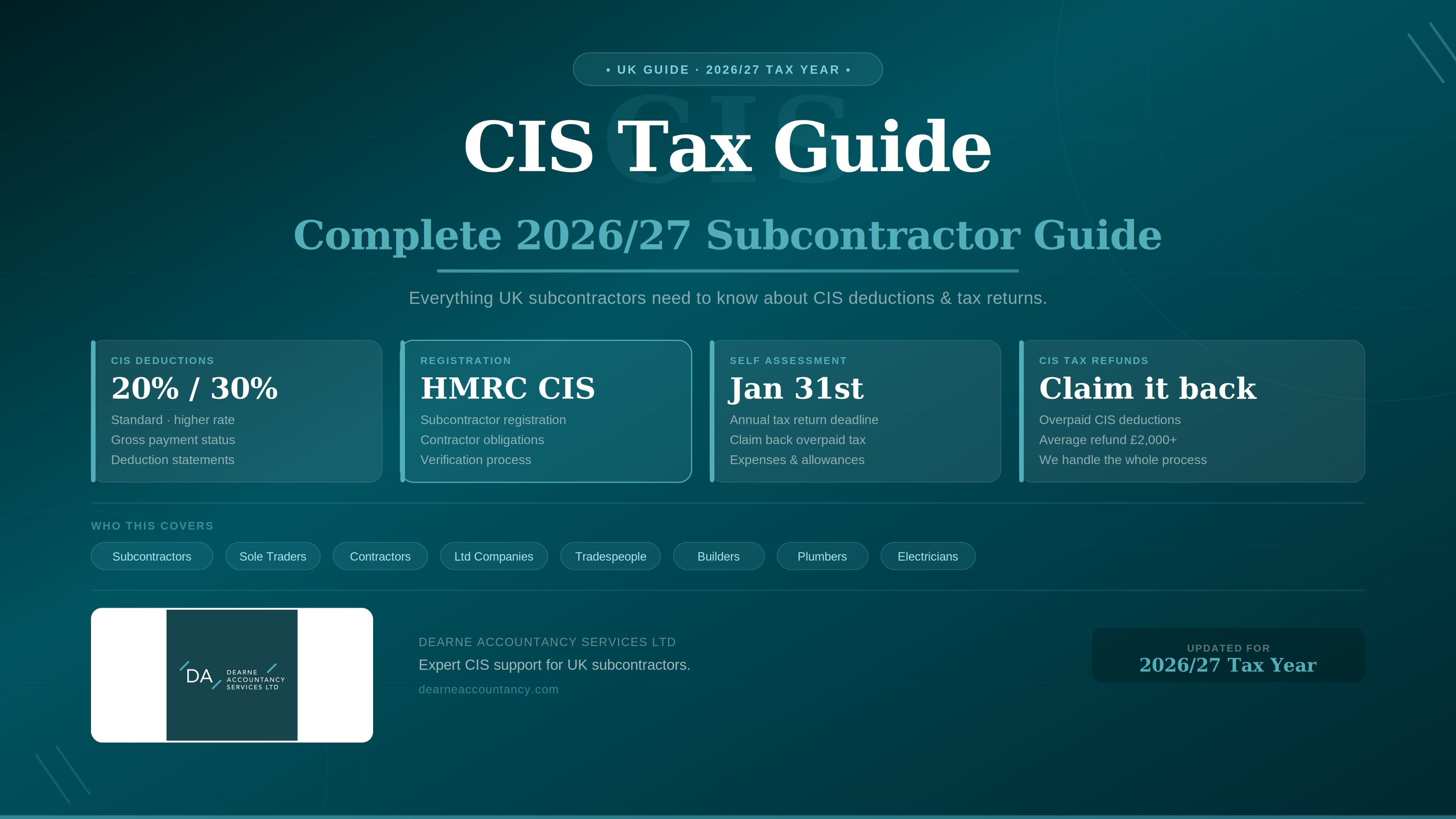
The Construction Industry Scheme requires contractors to deduct either 20% or 30% from a subcontractor's pay and pass it directly to HMRC. Most subcontractors overpay tax during the year because legitimate business expenses go unclaimed.
To recover what you are owed, you must file a self assessment tax return by 31 January each year. Subcontractors on the standard 20% rate typically receive refunds of between £500 and £3,000, depending on earnings and expenses claimed.
What Is the Construction Industry Scheme and Who Does It Cover?
The Construction Industry Scheme is an HMRC system that governs how tax is collected from workers in the UK construction industry.
Under CIS, contractors are legally required to deduct tax from subcontractor payments and send it directly to HMRC before the subcontractor ever sees the money. It applies to most construction work in the UK, including building, demolition, repairs, decorating, and civil engineering.
You are covered by CIS if you are a subcontractor doing construction work for a contractor. That includes sole traders, partnerships, and limited companies.
If you work directly for the contractor who controls your work and are treated as an employee, that is a different situation entirely. HMRC takes this distinction seriously and will investigate arrangements that look like disguised employment.
The scheme does not apply to work on your own home, professional services like architecture or surveying, or manufacturing materials off-site.
But if you are on a construction site being paid by a contractor, CIS almost certainly applies to you.
Before a contractor can pay you, they must verify you with HMRC. The result of that verification determines which deduction rate applies to you.
| Registration Type | Deduction Rate | What It Means |
|---|---|---|
| Verified subcontractor (standard) | 20% | Registered with HMRC and verified by your contractor before payment |
| Unverified subcontractor | 30% | Not registered or could not be verified by HMRC at the time of payment |
| Gross payment status | 0% | Applied for and approved by HMRC. Must meet turnover and compliance criteria |
Most subcontractors in South Yorkshire operate on the 20% standard rate. If you are on 30%, you almost certainly have money to claim back.
If you are on 20% but have not filed a self assessment return, you very likely do too. For the official HMRC overview of how the scheme works, visit the Construction Industry Scheme guidance on GOV.UK.
CIS Deduction Rates in 2026/27: What Gets Taken From Your Pay
Your deduction rate under CIS determines how much tax is taken before you receive payment. Understanding which rate you are on, and whether it is correct, is the first step to knowing whether you have a refund waiting.
Deductions are taken from the labour element of your payment only. Materials you supply are not subject to CIS deduction.
This is an important distinction many subcontractors miss. If your invoices include both labour and materials, your contractor should only deduct tax from the labour portion. Getting this wrong means overpaying from day one.
| Registration Status | Rate Applied To | Key Point |
|---|---|---|
| Verified (standard rate) | 20% on labour only | Materials shown separately on your invoice are excluded from deduction |
| Unverified | 30% on labour only | Register with HMRC as soon as possible to move to the standard 20% rate |
| Gross payment status | 0% | Must meet HMRC turnover, compliance, and business tests to qualify for this |
The deductions your contractor makes throughout the year count as tax paid on account. At the end of the tax year, when you file your self assessment return, HMRC calculates what you actually owe based on your total income minus your allowable expenses.
If the deductions taken during the year are more than what you owe, HMRC pays you the difference as a refund.
If you are on the 30% unverified rate, you are very likely to have overpaid significantly. Registering for CIS with HMRC and getting properly verified will move you to 20% going forward and should be done as soon as possible if you have not done so already.
What CIS Expenses Can You Claim as a Subcontractor?
This is the section that makes the biggest difference to how much tax you pay or get back. Most CIS subcontractors claim far fewer expenses than they are entitled to. Every pound of allowable business expense reduces your taxable profit, which directly reduces your tax bill or increases your refund.
| Expense Category | What You Can Claim | Notes |
|---|---|---|
| Tools and equipment | Tools purchased for work use | Keep receipts. Larger items may need to be spread over more than one year |
| Vehicle costs | 45p per mile (first 10,000 miles), 25p after | Travel between sites is claimable. Commuting to a permanent workplace is not |
| Protective clothing and PPE | Helmets, hi-vis, safety boots, gloves and other protective gear | Standard work clothes that are not protective gear are not claimable |
| Phone and broadband | Business use proportion only | Keep bills and estimate the percentage used for work purposes |
| Public liability insurance | Full premium | Directly relevant to CIS work and fully claimable |
| Professional subscriptions | Relevant trade memberships and professional fees | Must be directly related to your construction trade |
| Materials you supply personally | Cost of materials you purchase and use on jobs | Must not have been recharged to the client on the invoice |
| Accommodation | Overnight stays required for work away from your home base | Keep receipts. Must be genuine business travel, not a regular commute |
| Training | Training directly relevant to your current trade | Must relate to skills used in your existing construction work |
A few common mistakes to watch for. Ordinary clothes you wear on site are not claimable. Protective clothing and PPE are. Travel from home to a permanent workplace is not claimable.
Travel between sites, or from home to a temporary workplace, is. The HMRC approved mileage rate of 45p per mile for the first 10,000 miles is usually simpler than claiming actual vehicle costs, particularly for subcontractors with moderate annual mileage.
One point that catches people every year: tools and equipment you buy personally are fully claimable against your CIS income.
I see subcontractors who spend thousands on tools annually and have never once included them on a return. That is money left with HMRC every single year for no reason.
Our CIS returns service covers everything from gathering your receipts and invoices to submitting your return accurately, so you do not miss a thing.
How to File Your CIS Self Assessment Return and Claim Your Refund
Every CIS subcontractor must file a self assessment tax return each year. This is how HMRC reconciles the deductions your contractor has made throughout the year against what you actually owe. Without filing, HMRC keeps all the money. You must actively claim it back.
Step 1: Register for self assessment. Do this through HMRC's online system early in the process, not at the last minute. Registration can take a couple of weeks and you need your Unique Taxpayer Reference before you can file.
Step 2: Gather your CIS deduction statements. These should be provided monthly by your contractors. If a contractor has not given you statements, you can get your deduction figures from your HMRC online account.
Step 3: Add up all your allowable expenses for the tax year. Keep receipts. HMRC does not require you to send them in with your return, but you must be able to provide them if asked.
Step 4: Complete and submit your return online by 31 January. The tax year runs from 6 April to 5 April. The deadline to file and pay any additional tax owed is 31 January following the end of that tax year.
Step 5: Wait for HMRC to process your return. Any refund due is usually paid within five to six weeks, often faster if you file early in the year rather than in January.
One important point: you can claim CIS refunds for up to four previous tax years. If you have missed returns, it is not too late.
Penalties will apply for late filing, but in the majority of cases the refund recovered is larger than any penalties owed.
If you need help with your self assessment tax return, we handle the entire process from calculating your expenses to submitting directly to HMRC.
What CIS Subcontractors in South Yorkshire Actually Get Back
Generic articles about CIS refunds give you ranges. I can give you actual figures from our practice.
In the last 12 months, the average first-year CIS refund we recovered for new clients at Dearne Accountancy was £1,840. In many cases, that figure exceeded the annual accountancy fee. The biggest variable is not earnings. It is whether expenses have been properly claimed.
A roofer earning £35,000 a year who claims tools, PPE, mileage, phone, and insurance will get back considerably more than the same roofer who claims nothing. The difference in refund between a well-prepared return and a poorly prepared one can easily exceed £1,000 on the same level of earnings.
The subcontractors who receive the smallest refunds relative to their earnings are typically those using the most employer-supplied materials and claiming the fewest personal expenses.
The ones who consistently get the largest refunds are sole traders in trades with high personal equipment and travel costs. Roofers, groundworkers, and electricians tend to come out ahead compared to trades that rely more heavily on contractor-supplied materials.
We work with CIS subcontractors across the region every week. If you are looking for a CIS accountant in Rotherham or support for construction workers in Barnsley, we cover the full South Yorkshire area.
The Biggest CIS Mistakes That Cost Subcontractors Money Every Year
After 25 years of working with construction workers and contractors across South Yorkshire, the same mistakes come up time and time again. Knowing these will save you money.
Not registering for CIS at all. If you are working as a subcontractor but have not registered with HMRC, your contractor will deduct 30% rather than 20%. That extra 10% is sitting with HMRC unnecessarily. Registration is straightforward and should be done before you start work on any site.
Missing the self assessment deadline. The 31 January deadline carries automatic penalties. £100 for filing a single day late, rising significantly the longer you leave it. Filing late also delays your refund by months.
Not separating materials from labour on invoices. If your invoice bundles labour and materials together as one figure, your contractor may deduct CIS from the full amount. Always itemise your invoices clearly so deductions are applied to labour only.
Not applying for gross payment status when you qualify. Once your turnover and compliance record meet the HMRC criteria, gross payment status means no deductions are taken at all. Many subcontractors who qualify simply do not know it exists.
Not keeping records. You need receipts and invoices to back up expense claims. HMRC can enquire into any return for up to 12 months after filing, and longer in cases of suspected errors. A complete set of receipts is worth far more than most subcontractors realise.
HMRC's official guidance on self assessment tax returns covers the current filing requirements and deadlines in full.
FREQUENTLY ASKED QUESTIONS
Do I need to file a self assessment return as a CIS subcontractor?
Yes. Every CIS subcontractor must file a self assessment tax return at the end of each tax year. This is how HMRC works out whether the deductions taken by your contractor match what you actually owe.
Without filing, there is no refund. The deadline is 31 January following the end of the tax year. If you have never filed before, you need to register for self assessment with HMRC first, which can take a couple of weeks.
What is the CIS deduction rate for 2026/27?
The standard CIS deduction rate is 20% for verified subcontractors. Subcontractors who cannot be verified by HMRC are charged 30%. Those with gross payment status receive their full payment with no deductions at all.
Deductions are applied to the labour element of your payment only, not to materials. Checking which rate you are on is the first step to understanding what you may be owed.
How far back can I claim a CIS tax refund?
You can claim a CIS tax refund for up to four previous tax years. That means if you have not filed a self assessment return in several years, there may be a significant amount sitting with HMRC that you are entitled to.
Late filing penalties will apply for overdue returns, but the refund recovered often exceeds the penalty. It is almost always worth claiming rather than leaving the money with HMRC.
Can I claim mileage as a CIS subcontractor?
Yes, travel costs are one of the most commonly underclaimed expenses. You can claim 45p per mile for the first 10,000 business miles in a tax year, and 25p per mile after that. You cannot claim travel from home to a permanent workplace.
Travel from site to site, or from home to a temporary workplace, is claimable. Keeping a simple mileage log throughout the year makes this much easier to substantiate at return time.
What happens if my contractor does not give me CIS deduction statements?
Contractors are legally required to provide monthly deduction statements. If yours has not, request them in writing. If they still fail to provide them, you can find your deduction figures through your HMRC online account. Missing vouchers do not prevent you from filing your return, but sorting them out early avoids delays in processing your refund.
Finally!
The Construction Industry Scheme is straightforward once you understand how it works, but the difference between getting your return right and getting it wrong can run into thousands of pounds.
If you are a CIS subcontractor in the UK and you are not certain whether you are on the right deduction rate, whether you have claimed all the expenses you should have, or whether there are years of refunds sitting unclaimed with HMRC, book a free 30-minute audit at Dearne Accountancy.
We will go through your situation in full and tell you exactly where you stand, with no obligation.
Looking at the bigger picture for a Yorkshire construction Ltd? Our Construction Accountants Yorkshire hub covers CIS, the Domestic Reverse Charge, R&D tax credits and management accounts in one place.