
Most Ltd subbies I onboard have months of CIS sitting on HMRC’s records that never made it onto an EPS. Or did make it onto an EPS but the contractor’s monthly CIS300 doesn’t tie to it, so HMRC quietly rejected the offset and nobody chased. The money is there. The mechanic is the problem.
I’m Sarah Bingham. I run Dearne Accountancy Services out of Wath upon Dearne, working with construction Ltds across South Yorkshire and West Yorkshire. This is the playbook I run on every new Ltd subbie’s books in their first month with us. The mechanism’s not complicated. The discipline is.
The three rules that get a Ltd CIS-suffered claim through HMRC.
- Ltds claim via EPS, not Self Assessment. Submit your monthly Full Payment Submission as usual, then send an Employer Payment Summary showing the CIS deducted from your sales year-to-date. HMRC offsets it against PAYE, NIC, student loan and CIS-as-contractor liabilities in that order.
- Keep PDS plus bank statements together for every contractor payment. Each contractor’s Payment and Deduction Statement must be backed by a bank statement line showing the net amount landed in your account. HMRC’s verification team checks both.
- Current-year refunds go by post now. Since April 2024, year-end claims for the current tax year can no longer be submitted online — they go on paper to PT Operations North East England, BX9 1BX. Online stays available for prior tax years only.
Why this works differently for Ltd companies than for sole traders
If you’re a sole trader subbie, the CIS deducted from your sales drops into your Self Assessment return at year-end and HMRC nets it off your income tax bill (refunding anything left). That’s a once-a-year mechanic. The deeper version sits in the CIS pillar guide.
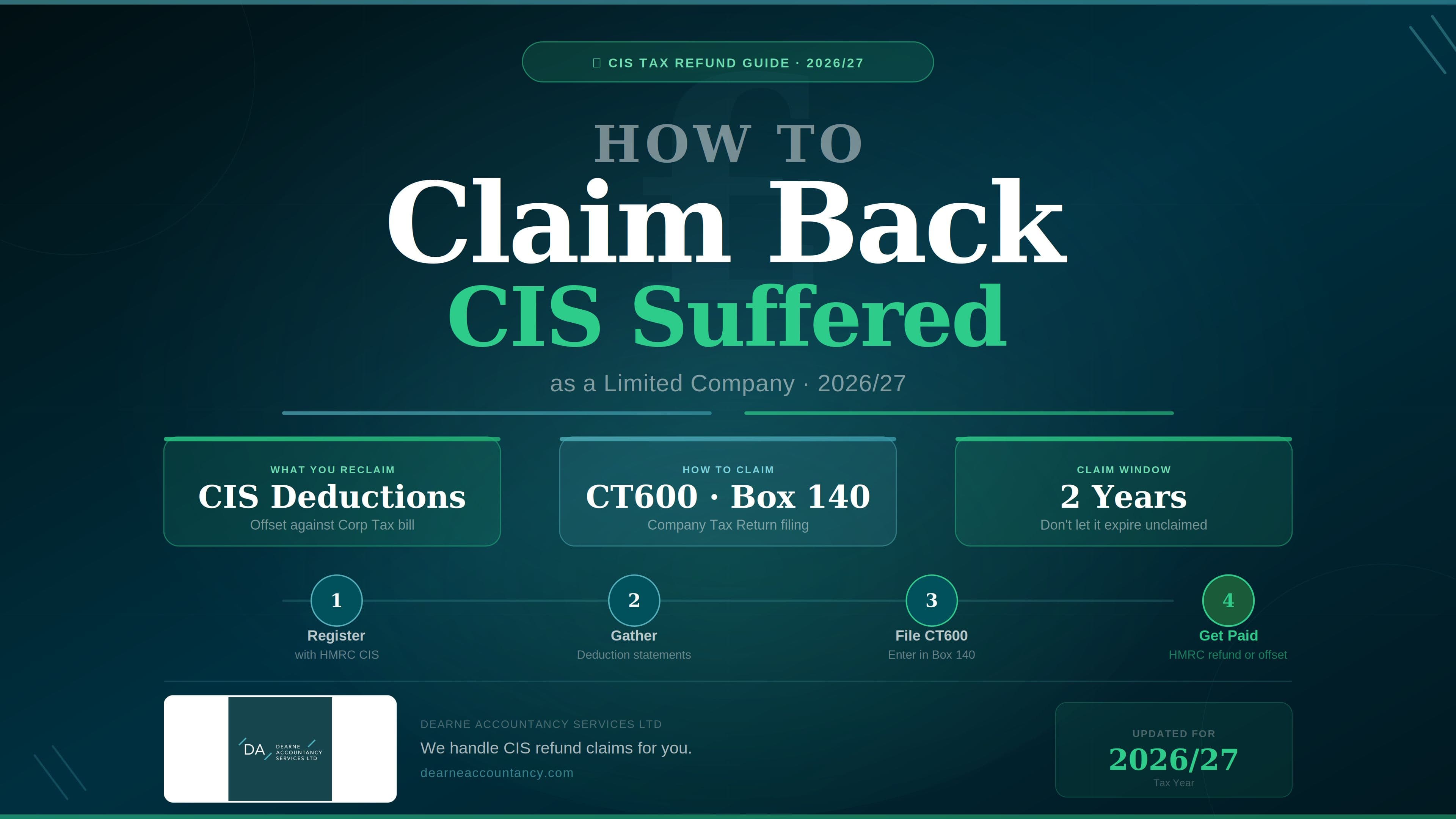
For a Limited Company subbie, the route is entirely different. You’re an employer with a PAYE scheme. HMRC treats your CIS suffered as a credit against the employer liabilities going through that PAYE scheme — month by month — through the Employer Payment Summary (EPS). The Corporation Tax return doesn’t see it. HMRC is explicit: “Do not try to claim back through your Corporation Tax return — you may get a penalty if you do.”
So the question for a Ltd isn’t “how do I claim my refund”. It’s: “is the monthly EPS doing its job, and what do I do with whatever’s left at year-end?”
The monthly EPS offset: how it works in practice
The mechanic is simple. The discipline is monthly.
Each month, alongside your Full Payment Submission (FPS) for staff wages, you send HMRC an Employer Payment Summary (EPS) that includes a single figure: total CIS deductions suffered, year to date. Not the month — the cumulative year-to-date figure.
That YTD figure tells HMRC how much credit to apply against your PAYE/NIC bill for the period. HMRC’s words: “HMRC offsets CIS deductions against PAYE tax and National Insurance owed.”
In practice this means:
- Month 1 (April): You suffered £2,400 of CIS. Your PAYE/NIC bill is £1,800. EPS shows £2,400 YTD. HMRC offsets £1,800. You pay £0 PAYE for the month. £600 of CIS suffered is stored against future liabilities.
- Month 2 (May): You suffer another £2,100 of CIS. PAYE/NIC bill is £1,800 again. EPS shows £4,500 YTD. HMRC has used £1,800 of last month’s £600 + £1,200 of this month’s £2,100. £1,500 cumulative surplus rolls forward.
- …and so on each month. (Figures illustrative only.)
When your PAYE bill hits zero with CIS-suffered left over, the surplus carries forward to the next month or quarter within the same tax year. It does not refund automatically mid-year.
The EPS deadline is the 19th of the following tax month — same as PAYE itself. Miss it and the offset doesn’t apply for that month; HMRC will chase the gross PAYE.
If you outsource payroll, this should already be happening — but check. The number we see most often in Ltd reviews is a YTD figure on the EPS that’s been frozen since some prior month because the payroll software wasn’t fed the latest PDS. Our payroll service and CIS returns service handle both ends as one workflow.
What CIS suffered gets offset against: the hierarchy
HMRC applies your CIS-suffered credit against employer liabilities in a fixed order each month. Understanding the order matters when you’re working out why the cash impact isn’t where you expected.
| Order | Liability offset against |
|---|---|
| 1 | PAYE income tax deducted from employees |
| 2 | National Insurance Contributions (employer + employee) |
| 3 | Student loan repayments deducted from employees |
| 4 | CIS deductions you’ve made from your own subcontractors (CIS-as-contractor) |
Worked the other way: if you’ve got £6,000 CIS suffered against £2,000 PAYE + £1,500 NIC + £400 student loan + £1,800 of CIS to pay over for your own subbies, HMRC applies the £6,000 in order — clearing PAYE first, then NIC, then student loan, then CIS-as-contractor — and you carry forward £300 (£6,000 − £5,700).
Most Yorkshire construction Ltds I work with operate both ends of CIS: they suffer it on the work they invoice up the chain, and they deduct it on payments to their own subbies. The fourth tier in the table matters — a healthy CIS suffered figure is the simplest way to neutralise your contractor liability for the month.
Year-end: claiming the surplus
Run the offset properly all year and one of three things happens:
- No surplus — the CIS suffered fully absorbed by your PAYE/NIC/student loan/CIS-as-contractor liabilities. Nothing more to do.
- Surplus — left-over CIS suffered the EPS couldn’t burn. You file a claim.
- Shortfall — you suffered less CIS than your liabilities. Pay the balance as normal.
For surplus claims, the route depends on which tax year the surplus relates to.
Prior tax year (2025/26 or earlier): Online claim via your business tax account at tax.service.gov.uk. Agent can claim with R38 or signed authority. No supporting documents required unless HMRC queries.
Current tax year (2026/27, after final EPS for the year): The April 2024 process change moved this to post. Send the claim, marked “CIS” on the envelope, to:
PT Operations North East England
HM Revenue and Customs
BX9 1BX
The written claim must include: company name, telephone, address, PAYE reference, Corporation Tax UTR, estimated overpayment amount, bank details for the refund, Payment and Deduction Statements (PDS) for every contractor that deducted CIS, and bank statements showing the net payment from each contractor landing in your account.
You can also tell HMRC to apply the surplus against:
- Corporation Tax bill
- VAT bill
- Future PAYE liability
Or take it as cash. Cash refunds typically land in 4–8 weeks once the claim’s accepted — slower if HMRC opens a verification query. Offset against Corp Tax is the fastest practical outcome for most Ltds because it kills the next due liability with no waiting for HMRC’s repayment queue.
Source: Claim a refund of CIS deductions if you’re a limited company (last updated 6 April 2026).
What HMRC actually wants to see
HMRC’s PAYE48250 manual (the action guide their verification team follows) lays out exactly what gets checked. The list to satisfy ahead of any current-year claim:
- Limited company status confirmed. HMRC checks the EPS was filed by a Ltd, not a sole trader or partnership.
- All FPS submissions filed up to month 12. A missing FPS will pause the whole claim.
- EPS year-to-date figure that ties to CISR. HMRC reconciles your EPS CIS-suffered figure against their CISR record of what contractors reported deducting from you. Mismatches trigger a query and stall the claim.
- A Payment and Deduction Statement (PDS) for every CIS deduction claimed. Issued by each contractor. The PDS must show the contractor’s name, address, employer reference, your name and verification number, the gross payment, the materials portion, the labour element, the tax deducted, and the period.
- Bank statements showing the net amount landed. Each PDS line must be matched to a bank statement entry for the net (post-deduction) figure.
- Subcontractor CIS verification. The contractor must have verified you with HMRC before paying you; that verification record is part of HMRC’s CISR cross-check.
- Correct PAYE reference on the claim. Mismatches between the EPS reference and the claim reference are a fast track to rejection.
The “do not claim via Corporation Tax return” rule sits in this same HMRC guidance and is enforceable with a penalty. Treat it as a hard line.
The six rejection reasons I see most often (and how to avoid them)
Drawn from HMRC’s PAYE48250 verification checks and what I see on incoming Ltd reviews.
- EPS figure greater than CISR record. Your YTD EPS says you suffered £24,000; HMRC’s CISR (built from contractors’ monthly CIS300 returns) says contractors only declared deducting £20,800 from you. HMRC will reject down to the lower figure until you can prove the £3,200 with PDS + bank statement evidence. Avoid: reconcile monthly, not at year-end.
- PDS missing entirely. Most common when a contractor’s payroll team forgets to issue them. The contractor is legally required to issue a PDS within 14 days of the end of each tax month. Avoid: chase PDS the week they’re late, in writing.
- PDS but no bank statement backing. Submitting the claim with PDS only invites HMRC to ask for the bank evidence. The claim stalls in queue. Avoid: every PDS gets stapled to its bank statement line at the time of filing.
- FPS gaps for the year. A missed FPS — even a nil-pay period — blocks the year-end claim until corrected. Avoid: file a nil EPS where you’ve had no employees that month.
- Subbie not properly verified by the contractor. Some contractors skip the verification call and just deduct at 30% (the unverified rate). HMRC won’t accept a CIS-suffered figure that’s bigger than what verified contractor records show. Avoid: confirm verification before the first invoice; correct the rate if it’s wrong.
- Corporation Tax cross-claim. The classic Ltd-director mistake — putting CIS suffered in Box 595 of the CT600. HMRC’s own warning: “Do not try to claim back through your Corporation Tax return — you may get a penalty if you do.” Avoid: Box 595 is for income tax deducted at source on individuals, not for Ltds. Leave it blank and route the claim through EPS.
Special cases worth knowing
A handful of situations need different handling.
- Gross Payment Status (GPS) holders. If your Ltd has GPS, contractors pay you gross and there’s no CIS to suffer. The EPS offset doesn’t apply because there’s nothing to offset. Worth re-checking GPS thresholds annually — losing GPS unexpectedly is a sudden cash-flow hit you can plan for.
- Dormant Ltds carrying historical CIS suffered. If a trading Ltd went dormant with unclaimed CIS surplus, the claim doesn’t die with the trading. File the year-end repayment claim for the year the deductions occurred, within the 4-year HMRC time limit.
- Mid-year deregistration from PAYE. If you close the PAYE scheme part-way through the tax year, the final EPS becomes the trigger for the year-end claim. The post route applies regardless of how much of the year has run.
- Contractor ceased trading before issuing the PDS. Contact HMRC PT Operations in writing with the contractor’s details, payment dates, and bank statement evidence. HMRC will reconstruct from their CISR record where possible.
Frequently asked questions
Can a Ltd claim CIS back through Self Assessment?
No. Self Assessment is for sole traders and individuals. A Ltd is a separate legal entity with its own Corporation Tax return — which itself is not the right route either. The only route for a Ltd to recover CIS suffered is the monthly EPS offset plus, where a surplus remains, a year-end refund claim through the company’s PAYE scheme.
How long do I need to keep PDS and bank statements?
HMRC’s general record-keeping rule for employers is six years. For CIS purposes specifically you need the records back for at least four years (the standard repayment time limit), but six is the safer practical floor because the records also support Corporation Tax and VAT enquiries.
What if my contractor never gave me a PDS?
The contractor is legally required to issue one within 14 days of the end of each tax month. Chase in writing. If the contractor refuses or has ceased trading, write to HMRC PT Operations with the contractor’s name and address, the dates and amounts of payments, and your bank statements showing receipt of the net figures. HMRC reconstructs from their CISR record where they can.
What’s the time limit for claiming back CIS suffered?
The general HMRC repayment time limit is four years from the end of the tax year in which the deductions were suffered. Beyond that, the claim is out of time and the money is lost.
Can I offset CIS suffered against my VAT or Corporation Tax bill instead of taking cash?
Yes. At year-end you can tell HMRC to apply the surplus against your next Corporation Tax bill, VAT bill, or future PAYE liability. Cash refunds typically take 4–8 weeks once accepted; offsets land faster because there’s no repayment-queue wait.
How long does HMRC take to pay a CIS surplus refund?
Most accepted claims pay out in 4–8 weeks. A current-year claim with full PDS + bank statement evidence moves faster than a thin one. Claims that trigger a CISR mismatch query can sit unresolved for months until the contractor’s records are rectified.
Want a second pair of eyes on your CIS suffered?
If you’re a Yorkshire construction Ltd and you haven’t reconciled your EPS CIS-suffered figures against your CISR record this year, that’s where I’d start. I run a free 30-minute CIS-suffered review for new Ltd contacts — bring your last 12 months of EPS submissions plus PDS statements and I’ll tell you whether HMRC owes you money. If they do, we’ll work out together whether it’s worth chasing. Get in touch.
Sources & further reading
- Claim a refund of CIS deductions if you’re a limited company (last updated 6 April 2026)
- What you must do as a CIS subcontractor — pay tax and claim back deductions
- PAYE48250 — Checking CIS deductions suffered (HMRC internal manual) (last updated 23 April 2026)