
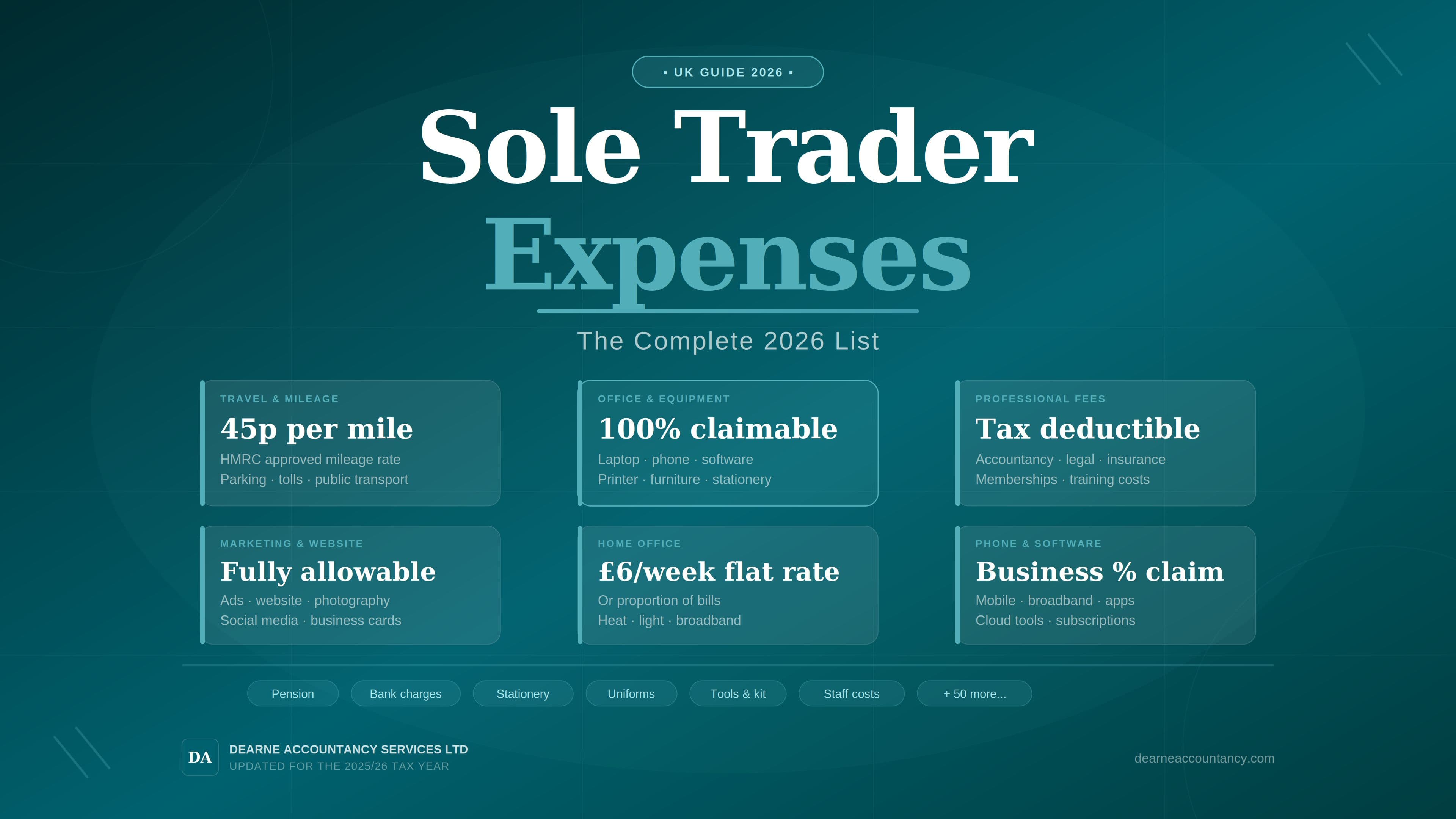
Sole trader expenses are one of the most effective - and most underused - ways to reduce your tax bill legally. Every allowable expense you claim reduces your taxable profit, which means less income tax and less National Insurance to pay.
Yet in 25 years of reviewing self assessment returns for small businesses and sole traders across South Yorkshire, I can tell you that underclaiming is far more common than overclaiming.
Most sole traders are paying more tax than they need to - not because they're doing anything wrong, but because they simply don't know what they're allowed to claim. This guide covers every category of sole trader expenses, exactly what qualifies, what doesn't, and the ones I see missed most often.
Quick Answer
Sole trader expenses are the costs of running your business that you deduct from your income before calculating tax. HMRC allows you to claim any expense incurred wholly and exclusively for business purposes.
The main categories are: office and admin costs, travel and vehicle costs, equipment and tools, premises and home office, phone and internet, staff and subcontractors, marketing, professional fees, insurance, bank charges, training, and pre-trading expenses. You claim them on your self assessment tax return each year.
The Golden Rule - What Makes a Sole Trader Expense Allowable?
Every sole trader expense claim comes down to one test set by HMRC: the expense must be incurred wholly and exclusively for the purposes of your trade. If you bought it purely for your business, you can claim it in full.
If it has a mix of business and personal use, you can claim the business proportion only. If the business and personal use cannot be separated at all, it is disallowed entirely.
In practice this means keeping records of what you spent, what it was for, and - where there is a personal element - a reasonable basis for how you worked out the business proportion. HMRC does not expect perfection. It does expect evidence.
One important point: sole trader expenses reduce your taxable profit, not your tax bill directly. But the effect is real. Every £1,000 of legitimate expenses claimed by a basic-rate taxpayer saves £200–£290 in tax and National Insurance combined.
For a higher-rate taxpayer, that saving rises to £420 or more. Getting your expenses right matters.
From April 2026, sole traders earning over £50,000 must keep digital records and submit quarterly updates to HMRC under Making Tax Digital for Income Tax.
The rules on what you can claim do not change under MTD - but if you are above that threshold, every expense needs to be recorded digitally as it happens. For full details on how this affects your return, see our self assessment service page.
The Complete Sole Trader Expenses List
The table below covers every main category of allowable sole trader expenses, what you can claim within each, what you cannot, and the most common mistake made in each category.
| Category | What you CAN claim | What you CANNOT claim | Common mistake |
|---|---|---|---|
| Office & admin costs | Stationery, postage, printer ink, computer software, subscriptions, cloud storage | Personal stationery, home printer purchased for personal use | Claiming 100% of a printer or laptop used partly for personal purposes |
| Phone & internet | Business proportion of mobile bill, broadband, second dedicated business line | Personal calls and personal data usage | Claiming the full phone or broadband bill without apportioning for personal use |
| Travel & transport | Train, bus, taxi fares for business journeys; parking (not fines); overnight accommodation; fuel or mileage for business trips | Commuting from home to your regular fixed workplace | Treating the daily drive to a regular site or office as a business journey - it isn't |
| Vehicle costs | 45p per mile for first 10,000 miles, 25p after (mileage method) OR actual costs: fuel, insurance, servicing, MOT, road tax - business proportion only | Personal journeys under either method; capital repayment on a vehicle loan | Mixing mileage rate and actual costs on the same vehicle - you must pick one and stick to it |
| Equipment & tools | Laptops, phones, specialist tools, machinery bought for business use. Capital allowances (Annual Investment Allowance) apply to larger purchases | Personal equipment, items with no business purpose | Forgetting the Annual Investment Allowance - large equipment can often be deducted 100% in year one, not spread over several years |
| Premises costs | Office rent, business rates, water, electricity, gas, security, cleaning - for a dedicated business premises | Mortgage capital repayment (interest is allowable); costs of buying or renovating premises | Claiming the full cost of a home used partly for business - you must apportion |
| Working from home | Flat rate (£10–£26/month based on hours worked) OR actual proportion of utility bills, rent/mortgage interest, council tax, internet based on rooms used and time spent | 100% of household bills; mortgage capital repayment; anything not directly related to business use | Using the flat rate when actual costs would produce a much larger, fully justifiable claim |
| Staff & subcontractors | Wages, salaries, bonuses, employer NIC, pension contributions, agency fees, payments to subcontractors for genuine work | Your own drawings (salary) as a sole trader - you pay tax on profit, not wages paid to yourself | Sole traders trying to deduct 'wages' paid to themselves - this is not allowable |
| Marketing & advertising | Website costs, hosting, domain, Google Ads, social media ads, business cards, printed materials, directory listings | Personal social media accounts, purely personal branding with no business purpose | Forgetting website hosting and domain renewals - these are fully allowable and often missed |
| Professional fees | Accountancy fees, tax return preparation, legal fees for business contracts, trade memberships, professional subscriptions and journals | Legal costs for personal matters, fines, penalties | Not claiming accountancy fees - the cost of Sarah doing your return is itself a claimable expense |
| Insurance | Public liability, professional indemnity, business contents, business interruption, employer's liability | Personal life insurance, private health cover for yourself | Forgetting public liability insurance - fully allowable and very commonly missed |
| Bank charges & interest | Business account fees, overdraft charges, interest on business loans, hire purchase interest, alternative finance charges | Personal loan repayments, personal credit card interest, capital repayment on loans | Claiming interest on a personal overdraft used for business - you need a business account to make this clean |
| Pre-trading expenses | Expenses incurred up to 7 years before you started trading - if you still use them in the business and they would have been allowable at the time | Costs incurred for a business that never actually started trading | Not knowing this rule exists - software, equipment, domain names bought before launch are all claimable on day one of trading |
| Training & development | Courses, training, and subscriptions that update or improve existing skills in your current trade | Training that prepares you for a new career or entirely different business - HMRC does not allow this | Confusing 'updating skills' (allowable) with 'learning a new trade' (not allowable) - the distinction is consistently applied by HMRC |
The Sole Trader Expenses Most Commonly Missed
Every accountant has a list of the expenses their new clients have been leaving on the table for years. Mine is very consistent.
These are the ones I find most often when I review a sole trader's returns for the first time - and the approximate annual value being lost in each case.
| Expense missed | Why it gets missed | Typical annual value missed |
|---|---|---|
| Use of home | People assume they can't claim unless they have a dedicated office. You can claim a proportion of any room used for business, even part-time. | £150–£400 depending on property size and energy costs |
| Full mileage at 45p/mile | Sole traders often claim fuel only, or forget to log short local journeys. At 45p per mile, 5,000 business miles = £2,250 deducted from profit. | £400–£900 for a typical tradesperson doing 3,000–5,000 business miles |
| Professional subscriptions | Trade body memberships, industry publications, professional software - these are fully allowable and almost always forgotten. | £50–£300 per year |
| Bank charges | Business account fees and charges are fully allowable. Many sole traders either don't have a dedicated business account or forget to include the charges. | £50–£200 per year |
| Pre-trading expenses | Costs incurred before you officially started trading - website, equipment, tools, software - can be claimed on your first return if incurred within 7 years. Almost nobody knows this rule. | £200–£1,500+ for new businesses with significant setup costs |
| Accountancy fees | The cost of having your self assessment return prepared is itself a claimable expense. Paying for Sarah to file your return reduces your taxable profit. | Full accountancy fee is deductible - often £200–£500 for a basic return |
Combined, these six categories alone account for between £400 and £900 in unnecessary tax for the average sole trader I see walk through the door.
And that's before we get to the bigger claims like mileage and working from home.
If you haven't had your expenses reviewed by an accountant in the last 12 months, there is a reasonable chance you are overpaying.
Vehicle Expenses - Mileage Rate vs Actual Costs
Vehicle expenses are where most sole traders either underclaim significantly or make an error that HMRC will challenge. There are two methods, and the choice matters.
Method 1 - HMRC Mileage Rate (Simplified Expenses)
You claim a flat rate per business mile driven. No need to track fuel, insurance, servicing, or depreciation separately. The rates are:
| Vehicle Type | First 10,000 miles | Over 10,000 miles | Best for |
|---|---|---|---|
| Car or van | 45p per mile | 25p per mile | Most sole traders with mixed personal/business vehicle use |
| Motorcycle | 24p per mile | 24p per mile | Couriers and traders using motorcycles for business |
| Bicycle | 20p per mile | 20p per mile | Local tradespeople, delivery, or consultants cycling to client sites |
At 45p per mile, a sole trader doing 8,000 business miles a year claims £3,600 deducted from taxable profit. Most sole traders I work with are doing at least this - tradespeople doing local call-outs, freelancers visiting clients, business owners attending meetings.
The mileage rate is almost always the simpler and often the better option for mixed-use vehicles.
Important: once you choose the mileage method for a vehicle, you must continue using it for the life of that vehicle.
You cannot switch to actual costs later. And you cannot claim capital allowances on the vehicle if you use the mileage rate - the rate covers all vehicle costs including depreciation.
Method 2 - Actual Costs
You claim the business proportion of every vehicle running cost: fuel, insurance, servicing, MOT, road tax, breakdown cover, and loan interest. You also claim capital allowances on the purchase price.
This method requires detailed records and a defensible method of calculating business use percentage.
For most sole traders with a vehicle used partly for personal journeys, the mileage rate is simpler and produces a comparable result.
Actual costs tend to make more sense only if the vehicle is used almost exclusively for business, or if it is a high-value vehicle where capital allowances produce a significantly larger deduction.
If you are unsure which method is better for your situation, our self assessment service includes a review of your vehicle expenses as standard.
Working From Home Expenses - Flat Rate vs Actual Costs
If you run any part of your business from home - answering emails, doing admin, taking client calls - you can claim a portion of your household costs as a sole trader expense. There are two methods here as well.
Method 1 - HMRC Flat Rate
HMRC sets a flat monthly amount based on the hours you work from home. You need to work at least 25 hours per month from home to use this method:
| Hours worked from home per month | HMRC flat rate (per month) | Who should use actual costs instead |
|---|---|---|
| 25–50 hours | £10 | Anyone with a dedicated home office taking up meaningful space and energy |
| 51–100 hours | £18 | Those with high utility bills or expensive rent/mortgage where actual proportion would be significantly higher |
| 101+ hours | £26 | In most cases of 100+ hours, actual costs will exceed the flat rate - worth calculating both before choosing |
The flat rate is simple - no calculations, no apportionment, no receipts needed beyond proof of hours worked.
For sole traders who do occasional admin from home, it is a reasonable option. But for those with a dedicated home office, or with high utility bills, the flat rate often leaves money on the table.
Method 2 - Actual Costs
You calculate the business proportion of your actual household costs: rent or mortgage interest, electricity, gas, water, council tax, internet.
You divide by the number of rooms used for business and the proportion of time used for business purposes.
Example: Your annual utility bills total £2,400. You have 5 rooms and use one as a home office for 40 hours a week - roughly 24% of waking hours.
You might reasonably claim 20% of your utility bills = £480. Compare that to the flat rate at 101+ hours: £312 per year.
The actual costs method is better here by £168 - and it gets more significant as bills rise.
For the full HMRC guidance on both methods, see HMRC's simplified expenses guidance. For a personalised calculation, book a free audit and we'll work out which method produces the better result for your specific situation.
Frequently Asked Questions - Sole Trader Expenses
Can I claim food and drink as a sole trader expense?
Only in specific circumstances. If you are travelling away from your normal place of work overnight, or on a trip that is wholly for business purposes, subsistence costs are allowable.
Your everyday lunch at your desk, or a coffee on the way to a regular site, is not. Entertaining clients is also not allowable - HMRC is consistent and strict on this.
Can I claim clothing as a sole trader expense?
Only if it is specialist protective or safety clothing required for your work - hi-vis, hard hats, steel-capped boots, PPE. Ordinary work clothes, even if you only wear them for work, are not allowable.
The reason is that clothing also provides warmth and decency, which is a personal benefit. Branded workwear is a grey area - HMRC accepts it in some cases but scrutinises claims, so get advice if this is significant for you.
Do I need receipts for every sole trader expense I claim?
Yes - HMRC can request evidence for any expense claimed on a self assessment return, and without a receipt or record the deduction will be denied. Keep every receipt, either physically or as a digital scan.
From April 2026, sole traders earning over £50,000 must keep digital records under Making Tax Digital. For everyone else, digital records are best practice regardless - apps like Dext or even a phone photo of every receipt will protect you if HMRC ever enquires.
Can I claim expenses if I also work as an employee?
Yes. If you are employed on PAYE for some of your income but also have self-employed income - for example a tradesperson who does their own work on the side - you file a self assessment return that covers both.
Your sole trader expenses are claimed against your self-employment income only. They do not reduce your PAYE employment income.
Can I claim expenses from before I started trading?
Yes - this is one of the most valuable rules most sole traders never know about.
You can claim pre-trading expenses incurred up to 7 years before your business officially started, as long as you still use them in the business and they would have been allowable had you been trading at the time.
This covers equipment, software, domain names, tools, and more. They are treated as if incurred on your first day of trading.
Not Sure What You're Missing?
Sole trader expenses are straightforward in principle - wholly and exclusively for business - but the detail is where most people lose money. The categories are clear enough.
What isn't clear, until someone sits down and goes through your actual situation, is which specific expenses you've been missing, whether your mileage or working-from-home method is producing the best result, and whether there are pre-trading costs or capital allowances you've never claimed.
If you're a sole trader in Barnsley, Rotherham, Sheffield, Doncaster, Leeds, or Wakefield and you haven't had your expenses reviewed properly, it is worth doing. Most of my new clients find something they've been missing - and in the majority of cases the tax saving in the first year more than covers the cost of the accountancy fee.
Book a free 30-minute audit at dearneaccountancy.com/book - no obligation, and you'll come away with a clear picture of what you should be claiming. Or if you'd like to find out more about how we handle sole trader returns first, visit our self assessment service page.