
If you work in construction and have CIS deductions taken from your pay every month, the chances are you're owed a CIS tax refund — and most subcontractors I speak to have no idea how much.
In 25 years of working with CIS contractors and subcontractors across South Yorkshire, the most common thing I hear is: "I didn't know I could claim that back."
This guide explains exactly what CIS tax refunds are, how much the average subcontractor receives, what expenses count, and what you need to do to claim every penny you're owed.
Quick Answer
CIS subcontractors typically receive refunds of between £500 and £3,000 per year, with most first-time claimants in South Yorkshire averaging closer to £1,500–£2,000.
CIS deductions made by your contractor throughout the year count as tax paid on account — most subcontractors overpay significantly because legitimate business expenses go unclaimed.
You must file a self assessment tax return to receive any refund from HMRC. You can also claim for up to 4 previous tax years.
What Is a CIS Tax Refund and Who Is Entitled to One?
Under the Construction Industry Scheme, contractors are required to deduct tax from payments made to subcontractors and pass it directly to HMRC. This happens before you ever see the money.
The deductions act as an advance payment towards your annual tax bill — but because they don't account for your personal allowance or business expenses, most subcontractors end up paying more than they actually owe.
A CIS tax refund is simply HMRC returning the amount you overpaid. To receive it, you file a self assessment tax return, declare your income, claim your allowable expenses, and HMRC calculates what you owed versus what was deducted. If the deductions are more than you owe — and for most subcontractors they are — the difference comes back to you.
All CIS subcontractors who have had deductions taken are potentially entitled to a refund. You don't need to be on a low income, and you don't need to have spotted the overpayment at the time — you just need to file a return.
CIS Deduction Rates and What They Mean for Your Refund
| Deduction Rate | Who Gets This Rate | Why a Refund Often Arises |
|---|---|---|
| 20% (Standard) | Verified subcontractors registered with HMRC | Expenses reduce taxable profit below earnings — refund very common |
| 30% (Higher) | Unregistered subcontractors | Almost always owed a refund — 30% is far too high for most |
| 0% (Gross payment) | Approved gross-payment subcontractors only | May still be owed money through legitimate expense claims |
How Much Is the Average CIS Tax Refund in South Yorkshire?
This is the question every subcontractor actually wants answered — and it's one no generic guide can give you properly, because it depends on your trade, your earnings, and whether you've been claiming your expenses.
What I can tell you is what I've seen from 25 years of doing this work across South Yorkshire. In the last 12 months, the average first-year CIS refund recovered for new clients at Dearne Accountancy was £1,840 — and in many cases that was more than the annual accountancy fee. The biggest factor isn't earnings.
It's whether expenses have been properly claimed. A roofer spending £4,000 a year on tools, materials, and van costs who has never claimed those expenses could be owed £800 or more above what they'd otherwise have received.
Different trades produce different refund profiles because the expense mix varies. In general:
- Roofers and general labourers: average first-year refund £1,400–£2,200
- Electricians and plumbers: average first-year refund £1,200–£1,900
- Groundworkers and civil engineers: average first-year refund £1,600–£2,400
- Painters and decorators: average first-year refund £900–£1,500
These ranges widen significantly if you've missed previous years. If you've been working in construction for 3 or 4 years without filing a return, the cumulative amount owed can be substantial — often well above £5,000.
If you're a CIS subcontractor in Rotherham, Barnsley, Sheffield, Doncaster, Leeds, or Wakefield and you've never claimed, it's worth getting a proper audit done before assuming the figure isn't worth pursuing.
What Expenses Can a CIS Subcontractor Claim Back?
The single most common reason CIS subcontractors get smaller refunds than they should is that they don't claim all their allowable expenses.
This is where working with an accountant who actually knows CIS — rather than a generic tax return service — makes a real difference.
Here are the main expense categories, what qualifies, and the mistakes that cost subcontractors money every year. For the full rules, see HMRC's guidance on CIS deductions
| Expense Type | What Counts | Common Mistake to Avoid |
|---|---|---|
| Tools & equipment | Power tools, hand tools, specialist equipment bought for work | Personal hobby tools don't count — must be for work use |
| Van & vehicle costs | Fuel, insurance, repairs, MOT — or claim 45p/mile (up to 10,000 miles) | Commuting to a permanent workplace does not qualify |
| PPE & workwear | Hi-vis, hard hats, steel-capped boots, gloves, overalls | Normal clothes don't qualify — must be protective or safety-required |
| Phone & broadband | Business proportion of mobile and broadband bills | You can only claim the business-use percentage, not the full bill |
| Materials | Materials you personally bought that weren't reimbursed by the contractor | Can't claim materials already covered by contractor |
| Public liability insurance | PL and contractor insurance policies | Keep receipts — this is often missed entirely |
| Training & subscriptions | CSCS cards, CITB training, professional memberships relevant to your trade | Must be trade-related, not general education |
IMPORTANT: Two common mistakes that cost subcontractors money every year:
1.Ordinary clothes (including branded workwear) don't qualify — only clothing required for safety protection counts.
2.Travel from home to a regular, fixed workplace (your main contractor's yard, for example) doesn't qualify as a business journey. Travel between different job sites does.
How to Claim Your CIS Tax Refund — Step by Step
The process is straightforward, but it needs to be done properly. Missing a step or filing incorrect figures can delay your refund or trigger an HMRC compliance check. Here's how it works:
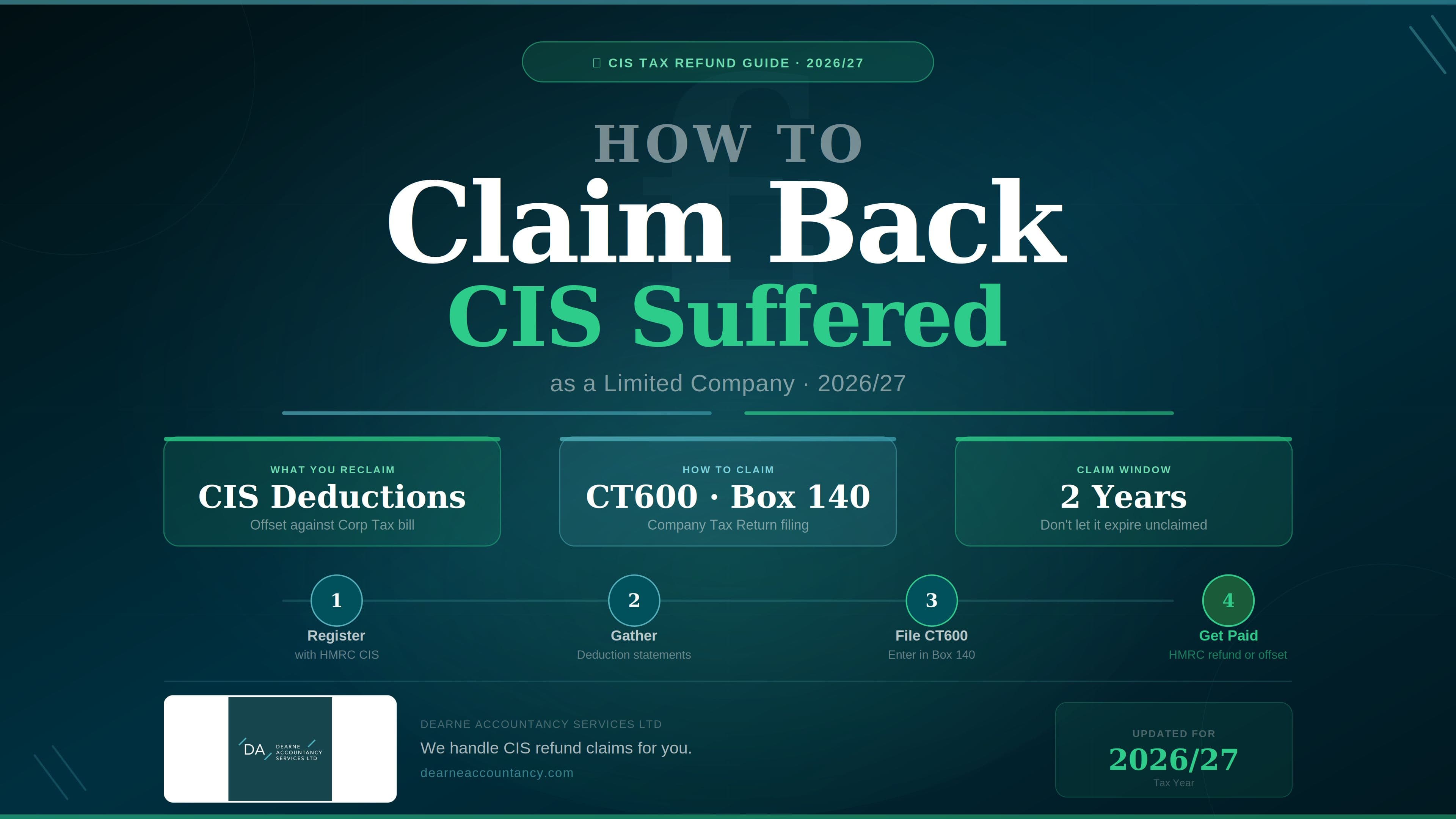
- Register for self assessment if you haven't already. Do this on the HMRC website. You'll need your National Insurance number and basic personal details. HMRC will post you a Unique Taxpayer Reference — you need this to file.
- Gather your CIS payment and deduction statements. You need one from every contractor you worked for during the tax year. These show the gross payments made to you and the CIS deductions taken. Your contractor is legally required to provide these.
- Total up all your allowable expenses. Use the categories in the table above. Keep receipts and bank statements — HMRC can ask for evidence if they carry out a compliance check.
- Complete your self assessment return. Declare your total CIS income, enter your allowable expenses, and include your CIS deductions in the relevant box. HMRC calculates the refund automatically.
- Submit before 31 January (online) or 31 October (paper). File online — it processes faster and refunds typically arrive within 5 to 8 weeks.
You can claim for up to 4 previous tax years. Our CIS returns service handles everything from gathering your statements to filing the return and dealing with HMRC on your behalf. We also cover self assessment tax returns for subcontractors with more complex income situations.
Frequently Asked Questions
How long does it take to receive a CIS tax refund from HMRC?
Once you've submitted your self assessment return, HMRC typically processes CIS refunds within 5 to 8 weeks. Filing online is always faster than paper — and filing early in the tax year gets your return processed before the January rush. Most of Sarah's clients at Dearne Accountancy receive their refunds within 6 weeks of filing.
Can I claim a CIS refund if I've never filed self assessment before?
Yes — and the sooner you start the better. You can backdate your claim up to 4 tax years, meaning you could be owed refunds as far back as 2021/22. Register for self assessment with HMRC first.
The penalties for late filing stop accruing once you engage, and the refund you're owed almost always outweighs any penalties accumulated.
Do I need an accountant to claim a CIS tax refund?
You don't legally need one — but the numbers suggest it pays to use one. Most CIS subcontractors who handle their own returns miss a significant portion of allowable expenses, particularly vehicle costs, tools, and insurance.
New clients at Dearne Accountancy who had previously self-filed were routinely missing between £300 and £800 worth of claimable expenses per year.
What if my contractor hasn't given me CIS payment and deduction statements?
You're legally entitled to these — contractors are required to provide them. If they haven't, contact them in writing.
If the contractor was unregistered or has gone under, contact HMRC directly on 0300 200 3210. You can still file using bank records and invoices as supporting evidence.
Can CIS subcontractors claim refunds for previous tax years?
Yes — you can go back up to 4 tax years. For 2025/26, that means claims as far back as 2021/22 are still open. If you've missed years, there may be late filing penalties — but the refund you'll recover almost always exceeds the penalties, often by a significant margin.
Find Out What You're Owed
Most CIS subcontractors in South Yorkshire are owed money — the only question is how much and whether they ever claim it.
If you've been working in construction and haven't filed your self assessment, or if you've been filing without claiming all your expenses, there's almost certainly a refund waiting.
The average first-year refund for new Dearne Accountancy clients is £1,840 — and for subcontractors who've missed multiple years, the total can be significantly higher.
Book a free 30-minute audit with us — there's no obligation and you'll leave knowing exactly where you stand. If you'd like to find out more about how we handle CIS returns first, visit our CIS returns service page.
Looking at the bigger picture for a Yorkshire construction Ltd? Our Construction Accountants Yorkshire hub covers CIS, the Domestic Reverse Charge, R&D tax credits and management accounts in one place.