
If you run a limited company, the split between your director salary and dividends is the single biggest lever you have over your personal tax bill in 2026/27. Get this combination right and you take home thousands more each year for exactly the same work. Get it wrong and you overpay tax unnecessarily or trigger an unexpected National Insurance liability that eats into the saving you thought you were making.
This guide sets out how both payment types are taxed, where the optimal salary sits after the April 2025 employer National Insurance changes, and how to structure your drawings at different profit levels.
QUICK ANSWER
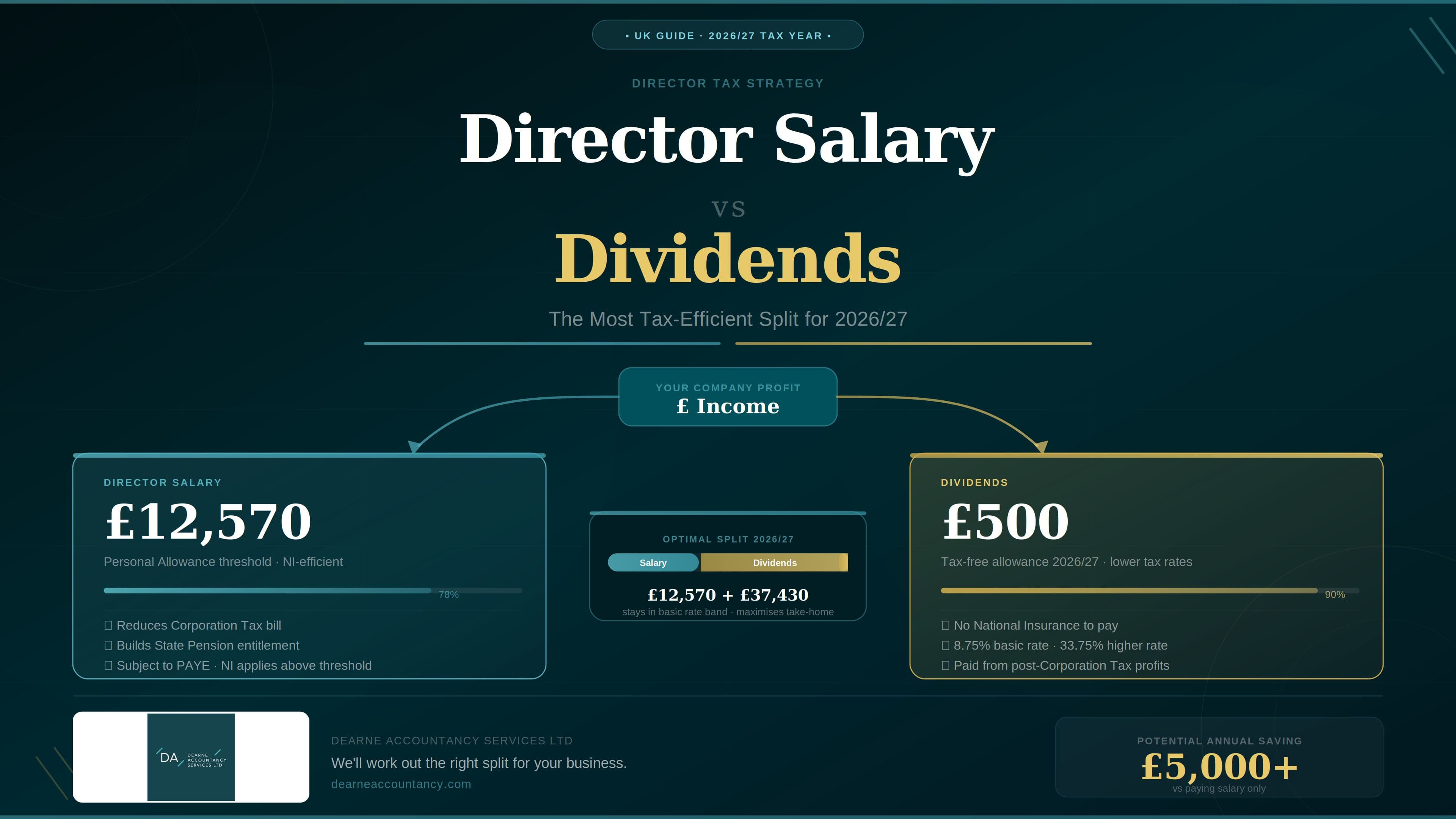
For most single-director companies in 2026/27, the optimal structure is a salary of £12,570 combined with dividends for everything else. The salary uses your full personal allowance so no income tax is due on it, and it generates a corporation tax deduction that outweighs the employer National Insurance cost.
Dividends are paid from post-tax profits and attract lower tax rates than income. Your exact optimal split depends on total company profit, whether Employment Allowance applies to your company, and whether you have income from any other source.
Why Salary and Dividends Are Taxed So Differently
The reason the salary and dividend split matters so much is that the two payment types go through completely different tax systems and carry different costs for both you personally and for the company.
A director salary is paid through payroll as employment income. It is subject to income tax via PAYE and, above certain thresholds, National Insurance on both the employee and employer side.
On the plus side, it is a deductible business expense for the company, which reduces the corporation tax bill. The company pays less corporation tax because the salary reduces its taxable profit before CT is calculated.
Dividends work differently. They are paid from company profits after corporation tax has already been deducted. There is no National Insurance on dividends, either for you personally or for the company.
Instead, you pay dividend tax at lower rates than income tax, but only above the annual dividend allowance of £500. The company gets no corporation tax deduction for paying a dividend because it comes from profit that has already been taxed.
The interaction between these two systems creates an opportunity. By taking a salary that is large enough to use your personal allowance and generate a CT deduction, but small enough to avoid or minimise National Insurance, and then taking the remainder as dividends, you can keep your overall tax rate significantly below what you would pay on the same income through salary alone.
| Tax or NI Type | On a Director Salary | On Dividends |
|---|---|---|
| Income tax | 20% basic, 40% higher, 45% additional (above personal allowance of £12,570) | 8.75% basic, 33.75% higher, 39.35% additional (above £500 dividend allowance) |
| Employee National Insurance | 8% between primary threshold and upper earnings limit, 2% above | None |
| Employer National Insurance | 15% on salary above the secondary threshold of £5,000 | None |
| Corporation tax deductibility | Yes. Salary and employer NI are both deductible business expenses | No. Dividends are paid from post-tax retained profits |
| When personal tax is paid | Via PAYE in real time through payroll | Via self assessment return by 31 January following the tax year |
| Payroll requirement | Yes. A PAYE scheme must be registered and run monthly | No payroll needed for dividends |
The Optimal Director Salary for 2026/27: Three Strategies Compared
The April 2025 Budget changes to employer National Insurance shifted the calculation that many directors had been using for years.
The employer National Insurance secondary threshold was reduced from £9,100 to £5,000, and the employer NI rate increased from 13.8% to 15%.
That combination means a director paying themselves £12,570 now faces an employer NI bill from the company, where previously there was none above £9,100.
Three salary strategies are commonly considered for single-director companies in 2026/27. Here is how they compare.
| Strategy | Annual Salary | Employer NI Cost to Company | Corporation Tax Saving | Net Position vs All Dividends |
|---|---|---|---|---|
| No salary | £0 | £0 | £0 CT deduction on salary | Entire personal allowance wasted. Less efficient overall |
| Salary at £5,000 | £5,000 | £0 (below secondary threshold) | Approx £950 CT saving (19% x £5,000) | Small but clean saving. Zero employer NI risk. Leaves £7,570 personal allowance unused but covered by tax-free dividends |
| Salary at £12,570 | £12,570 | Approx £1,136 (15% on £7,570 above threshold) | Approx £2,604 CT saving (19% on salary plus NI cost combined) | Net saving of approx £1,468 over all dividends. Still the most efficient option for most directors |
| Salary above £12,570 | Anything above £12,570 | 15% employer NI on full excess above £5,000 | CT deduction on full salary plus NI | Income tax kicks in above £12,570. Generally not efficient unless Employment Allowance applies |
For most single-director companies, salary at £12,570 remains the optimal choice in 2026/27. The employer National Insurance of approximately £1,136 is itself a deductible expense, so the corporation tax saving applies to the combined total of salary and NI. The net financial benefit over taking the same £12,570 purely as dividends is around £1,400 to £1,500 per year.
The picture changes significantly if your company qualifies for Employment Allowance. Employers with more than one director drawing a salary, or any other employee on the payroll, can claim Employment Allowance of up to £10,500 per year, which offsets employer NI entirely up to that amount.
If Employment Allowance applies, the employer NI cost disappears and a higher salary becomes even more attractive. Worth checking with your accountant whether your company qualifies.
For the HMRC guidance on running payroll and what your obligations are as an employer, the GOV.UK running payroll guidance covers the registration process and real time reporting requirements.
Dividend Tax in 2026/27: Rates, Allowances, and Where Higher Rate Kicks In
Dividend tax is calculated on the total of your dividends above the £500 annual allowance, but where those dividends sit within your overall income determines which rate applies. This is where a lot of directors lose money without realising it.
The basic and higher rate income thresholds for 2026/27 remain at £12,571 and £50,270. Dividends that fall within your unused personal allowance pay no tax at all.
Dividends above that, up to the total income threshold of £50,270, are taxed at 8.75%. Above £50,270, the rate jumps to 33.75%. That is nearly four times the basic rate. At higher profit levels, that jump has a material impact on your take-home pay.
| Where Dividends Fall in Your Total Income | Dividend Tax Rate | What This Means in Practice |
|---|---|---|
| Within your personal allowance of £12,570 | 0% | If your salary is below £12,570, dividends use the remaining allowance tax-free |
| Within the £500 annual dividend allowance | 0% | The first £500 of dividends above the personal allowance are always tax-free |
| Basic rate band (total income up to £50,270) | 8.75% | Most directors with company profits under £60,000 will sit entirely in this band |
| Higher rate band (total income £50,271 to £125,140) | 33.75% | Dividends here cost nearly four times the basic rate. Retaining profit in the company is worth considering at this level |
| Additional rate band (total income above £125,140) | 39.35% | Dividend efficiency drops sharply. Other planning strategies become more relevant at this income level |
The £500 dividend allowance has been at this level since April 2024 when it was halved from £1,000. There is no indication it will rise in the near term, so do not plan around an increase.
The allowance applies per person, so if your spouse or partner is also a shareholder in the company and receives dividends, they each have their own £500 allowance. Structuring share ownership to take advantage of a lower-earning spouse's unused allowances and personal allowance is a legitimate and commonly used planning approach.
You can read HMRC's own guidance on tax on dividends for the official treatment of dividends from UK companies and how to report them on your self assessment return.
A Full Worked Example: £65,000 Company Profit in 2026/27
Let me run through a complete worked example to show exactly where the numbers land. This is a single-director company, no other employees, no Employment Allowance, all profits drawn in the same year. Company profit before any drawings: £65,000.
| Step | Calculation | Amount |
|---|---|---|
| Company profit before salary | Starting point | £65,000 |
| Director salary paid | Deductible expense | £12,570 |
| Employer NI on salary (15% on £7,570 above £5,000 threshold) | Deductible expense | £1,136 |
| Remaining company profit after salary and NI | £65,000 minus £12,570 minus £1,136 | £51,294 |
| Corporation tax at 19% (small profits rate) | £51,294 x 19% | £9,746 |
| Post-tax profit available as dividend | £51,294 minus £9,746 | £41,548 |
| Director total personal income (salary plus dividend) | £12,570 plus £41,548 | £54,118 |
| Income tax on salary | Within personal allowance of £12,570 | £0 |
| Employee NI on salary | At or below primary threshold | £0 |
| Dividend allowance (first £500 tax-free) | Automatic annual allowance | £0 on first £500 |
| Dividends in basic rate band (up to £50,270 total income) | £50,270 minus £12,570 minus £500 = £37,200 at 8.75% | £3,255 |
| Dividends in higher rate band (total income above £50,270) | £54,118 minus £50,270 = £3,848 at 33.75% | £1,299 |
| Total personal dividend tax | £3,255 plus £1,299 | £4,554 |
| Total tax paid (CT plus employer NI plus dividend tax) | £9,746 plus £1,136 plus £4,554 | £15,436 |
| Director take-home pay after all taxes | £65,000 minus £15,436 | £49,564 |
| Effective overall tax rate | £15,436 divided by £65,000 | 23.7% |
Two things stand out in this example. First, the total income of £54,118 pushes just over the higher rate threshold of £50,270, meaning a portion of the dividends attract 33.75% rather than 8.75%. That £3,848 in higher rate dividends costs an extra £972 compared to what it would cost at the basic rate.
If the director had retained £4,000 in the company rather than drawing it as a dividend, that higher rate charge disappears entirely and the company holds the retained profit for future years.
Second, the effective all-in rate of 23.7% across £65,000 of profit is significantly lower than the equivalent sole trader rate, which would be approximately 25 to 26% at the same income level including Class 4 National Insurance.
The combination of salary and dividends is doing its job, but managing the higher rate threshold matters enormously at this profit level.
Five Factors That Change the Optimal Split for Your Situation
The worked example above covers the most common scenario, but several factors shift the calculation materially. These are the five most important ones I work through with clients at Dearne Accountancy.
Whether Employment Allowance applies
If your company qualifies, the employer NI cost on a salary above £5,000 disappears up to the £10,500 annual limit. This makes a higher salary considerably more attractive and changes the threshold at which salary becomes more efficient than dividends.
Whether your spouse or partner holds shares in the company
Paying dividends to a spouse who has unused personal allowance or is in a lower tax band is a legitimate and highly effective planning tool. A spouse receiving £12,570 in dividends pays no tax on them at all if they have no other income. That is a significant household tax saving for many families.
Whether you have income from other sources
Rental income, interest, pension drawdown, or employment elsewhere all count toward the basic and higher rate thresholds. A director who also draws rental income of £15,000 per year has much less room in the basic rate band for dividends before the 33.75% rate applies. The salary and dividend calculation must account for all income sources, not just company drawings.
Whether you are planning to leave profits in the company
Corporation tax at 19% is considerably cheaper than higher rate dividend tax at 33.75%. If you do not need to draw all the profit this year, leaving retained profit in the company and drawing it in a later year when your income is lower, or when you wind up the business, is often the most tax-efficient approach at higher profit levels.
Your pension contributions
Director pension contributions paid directly from the company are a deductible business expense that reduces corporation tax. They do not count as salary or dividends.
At higher profit levels, maximising pension contributions before drawing as dividends can reduce the overall tax bill substantially and should be part of any serious review of your annual drawings structure.
Our limited company accounting service covers the annual review of your salary and dividend split as standard, so your drawings are always structured correctly for your current profit level. We also handle your director self assessment return each year, ensuring your dividend income is reported accurately and your tax bill is exactly what it should be.
If you are based in Doncaster or the surrounding area and want a face-to-face review of your current structure, our Doncaster accountancy team covers the full Doncaster district.
FREQUENTLY ASKED QUESTIONS
What is the most tax-efficient director salary for 2026/27?
For most single-director companies without Employment Allowance, a salary of £12,570 remains the most tax-efficient option. This uses your full personal allowance so no income tax is due.
Employer National Insurance applies at 15% on the portion above £5,000, but the corporation tax deduction on both the salary and the NI cost produces a net saving of around £1,400 to £1,500 over taking the same amount as dividends.
Are dividends always more tax efficient than salary for a director?
No. A modest salary is almost always worth taking because it uses your personal allowance and generates a corporation tax deduction. Taking everything as dividends with no salary at all leaves part of your personal allowance wasted and forfeits the CT deduction.
The most efficient structure for most directors is a salary up to the personal allowance combined with dividends for the rest, not one or the other exclusively.
What is the dividend tax rate for basic rate taxpayers in 2026/27?
Basic rate taxpayers pay 8.75% on dividends above the £500 annual dividend allowance. Dividends within your unused personal allowance are free of tax entirely. Higher rate taxpayers pay 33.75% and additional rate taxpayers pay 39.35%.
The rate that applies depends on where your dividends sit within your total income for the year, including salary, rental income, and any other sources.
What is Employment Allowance and does it affect the salary calculation?
Employment Allowance lets eligible employers reduce their employer National Insurance bill by up to £10,500 per year. Single-director companies where the director is the sole employee cannot claim it.
If your company has at least one other employee on the payroll, or a second director receiving a salary, Employment Allowance is available. It significantly changes the salary calculation by removing the employer NI cost, making a higher salary far more attractive.
Do I need to run payroll as a limited company director paying myself a salary?
Yes. Any salary payment to a director requires a PAYE payroll scheme registered with HMRC. This means running payroll each month, submitting Real Time Information returns, and paying any tax or National Insurance owed.
The obligation applies even if the salary is small and no tax or NI is due. Most accountants include payroll administration within their limited company service package, which removes this burden from the director entirely.
Final Thoughts!
The salary and dividend split is not a one-time decision. It needs to be reviewed each year as your profit changes, as legislation changes, and as your personal circumstances shift. Getting it right consistently is worth thousands of pounds over the life of your company.
If you want to know whether your current structure is as efficient as it should be, book a free 30-minute review at Dearne Accountancy. We will run your actual numbers and tell you plainly whether there is money being left on the table.